Floating Island Recipe
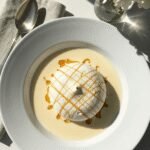
Classic French Floating Island (Île Flottante) features pillowy poached meringue clouds floating on silky vanilla custard, finished with delicate caramel threads. This elegant dessert looks impressive but uses simple techniques and everyday ingredients to create a showstopping finale for any special meal.
- Prep Time: 30 minutes
- Cook Time: 30 minutes
- Total Time: 1 hour (plus chilling time)
- Yield: 6 servings 1x
- Category: Dessert
- Method: Stovetop, Poaching
- Cuisine: French
- Diet: Vegetarian
Ingredients
Scale
For the Crème Anglaise (Vanilla Custard):
- 2 cups whole milk
- 1 cup heavy cream
- 6 large egg yolks
- ⅔ cup granulated sugar
- 2 teaspoons pure vanilla extract
- Pinch of salt
For the Meringue Islands:
- 6 large egg whites (room temperature)
- ⅓ cup granulated sugar
- ¼ teaspoon cream of tartar
- Pinch of salt
- 1 teaspoon vanilla extract
For the Caramel:
- ¾ cup granulated sugar
- 3 tablespoons water
Instructions
Make the Crème Anglaise:
- Heat the milk and cream: In a medium saucepan, combine the whole milk and heavy cream. Heat over medium heat until small bubbles form around the edges and the mixture is steaming (about 180°F), but don’t let it boil. Remove from heat and set aside.
- Whisk the egg yolks: In a large mixing bowl, whisk together the egg yolks, ⅔ cup sugar, and salt until the mixture becomes pale yellow and slightly thickened, about 2-3 minutes. This creates the base of your custard.
- Temper the eggs: This is the crucial step! Slowly pour about ½ cup of the hot milk mixture into the egg yolks while whisking constantly. This gradually raises the temperature of the eggs without scrambling them. Continue adding the hot milk mixture in a slow, steady stream while whisking continuously until all the milk is incorporated.
- Cook the custard: Pour the entire mixture back into the saucepan. Cook over medium-low heat, stirring constantly with a wooden spoon or heatproof spatula, until the custard thickens enough to coat the back of the spoon (about 170-175°F on a thermometer). When you draw your finger across the back of the spoon, it should leave a clear line. This takes about 8-10 minutes. Don’t let it boil or the eggs will curdle!
- Strain and cool: Immediately remove from heat and strain the custard through a fine-mesh strainer into a clean bowl to remove any bits of cooked egg. Stir in the vanilla extract. Place plastic wrap directly on the surface of the custard to prevent a skin from forming. Refrigerate until completely chilled, at least 2 hours or overnight.
Prepare the Meringue Islands:
- Set up your poaching liquid: Fill a large, wide skillet or sauté pan with about 2 inches of water. Heat over medium-low heat until barely simmering – you want gentle, barely bubbling water, not a rolling boil.
- Beat the egg whites: In a spotlessly clean bowl (any trace of fat will prevent proper whipping), beat the egg whites with an electric mixer on medium speed until foamy. Add the cream of tartar and salt, then increase speed to medium-high and beat until soft peaks form.
- Add sugar gradually: With the mixer running, gradually add the ⅓ cup sugar one tablespoon at a time, beating well after each addition. Continue beating until stiff, glossy peaks form and the sugar is completely dissolved (rub a bit of meringue between your fingers – it should feel smooth, not gritty). Beat in the vanilla extract.
- Poach the meringues: Using two large spoons, shape the meringue into egg-shaped ovals (quenelles). Gently slide them into the barely simmering water. Don’t overcrowd – poach 3-4 at a time. Poach for 2 minutes, then carefully flip them over with a slotted spoon and poach for another 2 minutes. The meringues should puff up and feel slightly firm to the touch.
- Drain and cool: Remove the poached meringues with a slotted spoon and place them on a clean kitchen towel or paper towels to drain. Let them cool to room temperature. You can prepare these several hours ahead and refrigerate them on a parchment-lined plate.
Make the Caramel:
- Cook the sugar: In a small, heavy-bottomed saucepan, combine the ¾ cup sugar and 3 tablespoons water. Swirl gently to combine (don’t stir). Heat over medium-high heat without stirring until the sugar dissolves and the mixture begins to boil.
- Caramelize: Continue cooking, swirling the pan occasionally, until the sugar turns a deep amber color (this happens quickly once it starts to color, so watch carefully!). Remove from heat immediately when it reaches the right color – it will continue to cook from residual heat.
- Create caramel threads: Working quickly (caramel hardens fast!), dip a fork into the hot caramel and drizzle it back and forth over the meringues in thin threads. You can also drizzle caramel directly over each serving. Alternatively, let the caramel cool slightly until it’s thick and syrupy, then drizzle it over the assembled desserts.
Assemble the Floating Islands:
- Plate the dessert: Pour the chilled crème anglaise into shallow dessert bowls or deep plates, filling them about halfway. Gently place one or two meringue islands on top of the custard in each bowl.
- Finish with caramel: Drizzle the caramel threads over the meringues or create a decorative caramel design on top. Serve immediately for the best texture contrast, or refrigerate for up to 2 hours before serving.
Notes
- Temperature control is key: The custard must cook low and slow to avoid curdling. If you see any signs of curdling, immediately remove from heat and strain through a fine sieve.
- Meringue texture: The poaching water should be at a bare simmer, not a rolling boil, or the meringues will fall apart.
- Caramel safety: Hot caramel can cause serious burns. Be extremely careful and keep children away from the stove during this step.
- Make it ahead: Both components can be made a day in advance and assembled just before serving for the freshest presentation.
- Size flexibility: You can make 6 large meringue islands or 12 smaller ones depending on your preference.
Nutrition
- Serving Size: 1 dessert (with custard and meringue)
- Calories: 385
- Sugar: 52g
- Sodium: 145mg
- Fat: 16g
- Saturated Fat: 9g
- Unsaturated Fat: 6g
- Trans Fat: 0g
- Carbohydrates: 55g
- Fiber: 0g
- Protein: 8g
- Cholesterol: 265mg
Find it online: https://focialy.com/floating-island-recipe/