Velvet Cake Recipe
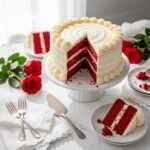
This classic red velvet cake features three layers of perfectly moist, tender crimson cake with subtle cocoa flavor, topped with rich cream cheese frosting. It’s the ultimate celebration cake that’s surprisingly easy to make at home with simple ingredients and clear instructions.
- Prep Time: 25 minutes
- Cook Time: 30 minutes
- Total Time: 55 minutes (plus cooling time)
- Yield: 12-16 servings 1x
- Category: Dessert
- Method: Baking
- Cuisine: American
- Diet: Vegetarian
Ingredients
For the Cake:
- 2½ cups all-purpose flour
- 2 tablespoons unsweetened natural cocoa powder
- 1 teaspoon baking soda
- 1 teaspoon salt
- 1½ cups granulated sugar
- 1½ cups vegetable oil
- 2 large eggs, room temperature
- 1 cup buttermilk, room temperature
- 2 tablespoons red food coloring (liquid) or 1-2 teaspoons gel food coloring
- 1 teaspoon white vinegar
- 1 teaspoon pure vanilla extract
For the Cream Cheese Frosting:
- 16 oz (two 8-oz packages) cream cheese, softened to room temperature
- ¾ cup (1½ sticks) unsalted butter, softened to room temperature
- 5 cups powdered sugar, sifted
- 2 teaspoons pure vanilla extract
- Pinch of salt
Instructions
Prepare the Pans and Oven:
- Preheat your oven to 350°F (175°C). Grease two 9-inch round cake pans with butter or non-stick spray, then line the bottoms with parchment paper circles. Grease the parchment as well and lightly dust with flour, tapping out the excess.
Mix the Dry Ingredients: 2. In a medium bowl, sift together the flour, cocoa powder, baking soda, and salt. Sifting is important to remove lumps and ensure even distribution. Set aside.
Combine Wet Ingredients: 3. In a large mixing bowl, whisk together the sugar and vegetable oil until well combined. Add the eggs one at a time, beating well after each addition until the mixture is smooth and slightly thickened.
- In a small bowl or measuring cup, combine the buttermilk, red food coloring, vinegar, and vanilla extract. Stir until the color is evenly distributed.
Combine Everything: 5. Add the dry ingredients to the sugar-oil-egg mixture in three additions, alternating with the buttermilk mixture, beginning and ending with the dry ingredients. Mix on low speed or stir by hand just until combined after each addition. Do not overmix—stop as soon as you no longer see streaks of flour.
Bake the Cakes: 6. Divide the batter evenly between the prepared pans (use a kitchen scale for precision if desired—each pan should have about 24-25 oz of batter). Smooth the tops with a spatula.
- Bake for 28-32 minutes, or until a toothpick inserted into the center comes out with just a few moist crumbs (not wet batter). The cakes should spring back when lightly pressed.
- Remove from oven and let cool in the pans for 10 minutes, then carefully turn out onto wire cooling racks. Peel off the parchment paper and let cool completely before frosting (this takes about 1-2 hours).
Make the Cream Cheese Frosting: 9. While the cakes cool, prepare the frosting. In a large bowl using an electric mixer, beat the softened cream cheese and butter together on medium speed for 2-3 minutes until completely smooth and creamy with no lumps.
- Reduce speed to low and gradually add the sifted powdered sugar, one cup at a time, beating until incorporated. Add the vanilla extract and salt.
- Increase speed to medium-high and beat for 2-3 minutes until the frosting is light, fluffy, and spreadable. If it’s too thick, add 1-2 tablespoons of heavy cream or milk. If too thin, add more powdered sugar ¼ cup at a time.
Assemble the Cake: 12. Place one cake layer on your serving plate or cake stand. If the tops are domed, use a serrated knife to level them for easier stacking.
- Spread about 1 cup of frosting over the first layer, spreading it evenly to the edges. Place the second cake layer on top, pressing down gently.
- Apply a thin “crumb coat” of frosting over the entire cake to seal in crumbs. Refrigerate for 15-20 minutes to set.
- Apply the final layer of frosting, using an offset spatula to create smooth sides and top, or decorative swirls as desired. Decorate with cake crumbs around the bottom edge if desired.
Notes
- Room Temperature Ingredients: This is crucial! Cold ingredients don’t incorporate properly and can cause the batter to curdle or the frosting to be lumpy.
- Food Coloring Amount: Start with less food coloring and add more if needed. Gel colors are more concentrated than liquid.
- Don’t Overmix: Overmixing develops gluten and creates a tough, dense cake. Mix just until you don’t see dry flour.
- Buttermilk Substitute: If you don’t have buttermilk, mix 1 cup whole milk with 1 tablespoon white vinegar or lemon juice. Let sit 5 minutes before using.
- Cake Flour Option: For an even more tender crumb, substitute cake flour (2¾ cups cake flour for 2½ cups all-purpose flour).
Nutrition
- Serving Size: 1 slice (1/12 of cake)
- Calories: 685
- Sugar: 68g
- Sodium: 385mg
- Fat: 38g
- Saturated Fat: 14g
- Unsaturated Fat: 22g
- Trans Fat: 0g
- Carbohydrates: 82g
- Fiber: 1g
- Protein: 6g
- Cholesterol: 95mg
Find it online: https://focialy.com/velvet-cake-recipe/