Wedding Cake Recipe
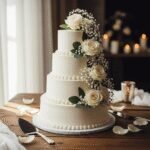
This elegant vanilla wedding cake features four layers of moist, tender almond-vanilla cake paired with silky Swiss meringue buttercream. Bakery-quality results that you can achieve at home with patience and the right techniques.
- Prep Time: 1 hour
- Cook Time: 35 minutes
- Total Time: 4 hours (including cooling and assembly)
- Yield: 60-75 servings 1x
- Category: Dessert
- Method: Baking
- Cuisine: American
- Diet: Vegetarian
Ingredients
Scale
For the Vanilla Almond Cake (makes 4 nine-inch layers):
- 6 cups cake flour, spooned and leveled
- 2 tablespoons baking powder
- 1½ teaspoons salt
- 2 cups (4 sticks) unsalted butter, room temperature
- 4 cups granulated sugar
- 12 large egg whites, room temperature
- 2 cups whole milk, room temperature
- 2 tablespoons pure vanilla extract
- 1 tablespoon pure almond extract
For the Swiss Meringue Buttercream (enough for filling and frosting):
- 10 large egg whites
- 2½ cups granulated sugar
- ¼ teaspoon salt
- 5 cups (10 sticks) unsalted butter, room temperature, cut into tablespoons
- 2 tablespoons pure vanilla extract
- 1 teaspoon pure almond extract
Instructions
For the Cake Layers:
- Prepare your pans: Preheat oven to 350°F (175°C). Grease three 9-inch round cake pans thoroughly with butter or baking spray. Line the bottoms with parchment paper circles, then grease the parchment. Lightly dust with flour and tap out excess. If using cake strips, soak them and wrap around pans.
- Combine dry ingredients: In a large bowl, whisk together the cake flour, baking powder, and salt. Set aside.
- Cream butter and sugar: In the bowl of a stand mixer fitted with the paddle attachment, beat the room-temperature butter on medium speed for about 2 minutes until smooth. Gradually add the sugar and beat on medium-high speed for 4-5 minutes until light, fluffy, and nearly white in color. Stop and scrape down the bowl several times.
- Add egg whites gradually: With the mixer on medium-low speed, add the egg whites one at a time, beating well after each addition. The mixture may look slightly curdled—this is normal. Scrape down the bowl as needed.
- Combine wet ingredients: In a liquid measuring cup, combine the milk, vanilla extract, and almond extract.
- Alternate additions: With the mixer on low speed, add the flour mixture in three additions, alternating with the milk mixture in two additions (begin and end with flour). Mix each addition just until incorporated—do not overmix. After the final addition, finish mixing by hand with a rubber spatula, scraping the bottom and sides to ensure no pockets of flour remain.
- Bake the first batch: Divide the batter evenly among the three prepared pans (about 3 cups of batter per pan for even layers). Smooth the tops with an offset spatula. Gently tap the pans on the counter 2-3 times to release air bubbles. Bake for 28-35 minutes, until a toothpick inserted in the center comes out clean and the tops spring back when lightly pressed.
- Cool properly: Let cakes cool in pans on wire racks for 15 minutes, then carefully invert onto racks. Remove parchment paper and flip right-side up to cool completely. Repeat the entire process to make your fourth layer (or make all four at once if you have four pans).
- Prepare for assembly: Once completely cool, wrap each layer tightly in plastic wrap and refrigerate for at least 2 hours or freeze for easier handling. This makes frosting much easier and results in cleaner, more professional layers.
For the Swiss Meringue Buttercream:
- Create the meringue: Combine egg whites, sugar, and salt in the heatproof bowl of your stand mixer. Place the bowl over a pot of simmering water (don’t let the bowl touch the water). Whisk constantly by hand until the sugar is completely dissolved and the mixture reaches 160°F on a candy thermometer, about 3-5 minutes. You should not feel any grains of sugar when you rub a bit between your fingers.
- Whip to stiff peaks: Transfer the bowl to your stand mixer fitted with the whisk attachment. Beat on medium-high speed for 10-12 minutes until the meringue forms stiff, glossy peaks and the bowl is cool to the touch.
- Add butter gradually: Reduce speed to medium-low. Add the butter one tablespoon at a time, waiting until each piece is incorporated before adding the next. The mixture may look curdled or soupy at some point—keep mixing! It will come together into silky buttercream.
- Flavor and finish: Once all the butter is incorporated and the buttercream is smooth, add the vanilla and almond extracts. Beat on low speed for 1-2 minutes. If the buttercream seems too soft, refrigerate for 15 minutes, then beat again. If it seems too stiff, briefly warm the bowl with a warm towel and beat until smooth.
Assembly:
- Level layers: Using a long serrated knife or cake leveler, trim the domed tops off each cake layer to create flat, even surfaces.
- Create a crumb coat: Place one cake layer on a cake board or serving plate. Spread a generous layer of buttercream on top (about ¾ cup). Repeat with remaining layers, stacking evenly. Apply a thin layer of frosting all over the cake—this is your crumb coat. Refrigerate for 30 minutes until firm.
- Final frosting: Apply a thicker layer of buttercream all over the chilled cake. Use an offset spatula and cake turntable to create smooth sides. For sharp edges, use a bench scraper held at a 90-degree angle while spinning the turntable.
- Decorate: Pipe borders, add fresh flowers, or keep it elegantly simple. Refrigerate until 1 hour before serving for best texture.
Notes
- Room temperature ingredients are crucial – They incorporate more evenly and create better texture
- Don’t skip the crumb coat – This prevents crumbs from ruining your final frosting layer
- Buttercream troubleshooting – If it curdles during mixing, keep beating; if it’s soupy, chill briefly then beat again
- For a taller cake, use deeper pans (2 inches instead of 1.5 inches) and adjust baking time to 35-40 minutes
- Flavor variations – Add lemon zest, use different extracts, or incorporate freeze-dried fruit powder for color and flavor
Nutrition
- Serving Size: 1 slice (based on 75 servings)
- Calories: 385
- Sugar: 32g
- Sodium: 145mg
- Fat: 22g
- Saturated Fat: 14g
- Unsaturated Fat: 7g
- Trans Fat: 0g
- Carbohydrates: 44g
- Fiber: 0.5g
- Protein: 3g
- Cholesterol: 60mg
Find it online: https://focialy.com/wedding-cake-recipe/