Yellow Cake Recipe
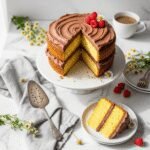
This classic homemade yellow cake is perfectly moist, fluffy, and buttery with a tender crumb that melts in your mouth. Made completely from scratch with simple ingredients, it’s far superior to any box mix and easier than you think! Perfect for birthdays, celebrations, or any time you want a delicious homemade dessert.
- Prep Time: 20 minutes
- Cook Time: 28 minutes
- Total Time: 48 minutes
- Yield: 12 servings 1x
- Category: Dessert
- Method: Baking
- Cuisine: American
- Diet: Vegetarian
Ingredients
Scale
- 2 ½ cups (315g) all-purpose flour
- 2 ½ teaspoons baking powder
- ½ teaspoon baking soda
- ¾ teaspoon salt
- 1 ¾ cups (350g) granulated sugar
- ¾ cup (170g) unsalted butter, softened to room temperature
- ¼ cup (60ml) vegetable oil
- 4 large eggs, at room temperature
- 1 tablespoon pure vanilla extract
- 1 cup (240ml) buttermilk, at room temperature
Instructions
- Preheat and Prepare: Preheat your oven to 350°F (175°C). Grease two 9-inch round cake pans with butter or non-stick spray, line the bottoms with parchment paper circles, then grease the parchment. Lightly dust with flour and tap out the excess. This ensures easy release after baking.
- Combine Dry Ingredients: In a medium bowl, whisk together the flour, baking powder, baking soda, and salt. Sift the mixture twice to ensure there are no lumps and the leavening agents are evenly distributed. Set aside.
- Cream Butter and Sugar: In a large bowl or stand mixer fitted with the paddle attachment, beat the softened butter on medium speed for about 1 minute until smooth and creamy. Gradually add the sugar and continue beating on medium-high speed for 4-5 minutes until the mixture is light, fluffy, and pale in color. This creaming process is crucial for a light texture! Scrape down the sides and bottom of the bowl as needed.
- Add Oil: Pour in the vegetable oil and beat on medium speed for about 30 seconds until fully incorporated. The mixture should look smooth and glossy.
- Incorporate Eggs: Add the eggs one at a time, beating well after each addition (about 30 seconds per egg) until fully incorporated. After all eggs are added, mix in the vanilla extract. The mixture may look slightly curdled at this point – that’s completely normal!
- Alternate Wet and Dry Ingredients: With the mixer on low speed, add the flour mixture in three additions, alternating with the buttermilk in two additions. Begin and end with the flour mixture. Mix each addition just until combined – don’t overmix! The pattern should be: 1/3 flour, 1/2 buttermilk, 1/3 flour, 1/2 buttermilk, 1/3 flour. Use a rubber spatula to scrape the bottom of the bowl and give a few final gentle folds to ensure everything is incorporated.
- Divide and Bake: Divide the batter evenly between your prepared pans (use a kitchen scale for precision if you have one – about 650g per pan). Smooth the tops with an offset spatula. Tap the pans gently on the counter 2-3 times to release any air bubbles.
- Bake: Bake for 26-28 minutes, or until a toothpick inserted into the center comes out with just a few moist crumbs (not wet batter). The cakes should spring back when lightly pressed, and the edges should be just starting to pull away from the sides of the pan. Start checking at 25 minutes to prevent overbaking.
- Cool Properly: Remove from the oven and let the cakes cool in the pans on wire racks for exactly 15 minutes. This allows them to set without becoming soggy. After 15 minutes, run a knife around the edges, invert the pans onto the cooling racks, and carefully remove the pans and parchment paper. Let the cakes cool completely before frosting (at least 1 hour).
Notes
- Room Temperature Matters: Make sure your butter, eggs, and buttermilk are at room temperature. Cold ingredients don’t mix well and can result in a dense cake.
- Don’t Overmix: Once you add the flour, mix just until combined. Overmixing develops gluten and creates a tough, dense cake.
- Even Layers: If your cakes dome in the center, use a serrated knife to level them before frosting for professional-looking layers.
- High Altitude: If baking above 3,000 feet, reduce baking powder to 2 teaspoons and increase flour by 2 tablespoons.
- Testing Doneness: Your cake is done when a toothpick comes out with a few moist crumbs – not completely clean. A completely clean toothpick means overbaked!
- Pan Size Variations: This recipe also makes 24 cupcakes (bake 18-20 minutes) or one 9×13-inch sheet cake (bake 30-35 minutes).
Nutrition
- Serving Size: 1 slice (1/12 of cake, unfrosted)
- Calories: 385
- Sugar: 32g
- Sodium: 285mg
- Fat: 18g
- Saturated Fat: 9g
- Unsaturated Fat: 8g
- Trans Fat: 0g
- Carbohydrates: 51g
- Fiber: 1g
- Protein: 6g
- Cholesterol: 95mg
Find it online: https://focialy.com/yellow-cake-recipe/