Easy Homemade Funnel Cake Recipe – Crispy, Golden & Carnival-Perfect!

There’s nothing quite like biting into a warm, crispy funnel cake dusted with powdered sugar—it’s like bringing the carnival home to your kitchen! This homemade funnel cake recipe captures all that nostalgic, fair-food magic with a perfectly crispy exterior, fluffy interior, and that signature twisted, lacy pattern we all love. Whether you’re craving a taste of summer festivals, planning a backyard party, or just want to treat your family to something special, these funnel cakes deliver authentic carnival flavor without leaving your house.
What makes funnel cakes so irresistible is their unique texture—crispy and golden on the outside, soft and cake-like on the inside, with all those delicious crispy edges from the swirled batter. The fun starts the moment you pour the batter into hot oil and watch it sizzle and puff up into beautiful, irregular patterns. And the best part? This recipe uses simple pantry ingredients you probably already have, and the entire process from mixing to eating takes less than 30 minutes.
Funnel cakes are incredibly versatile too. The classic version with powdered sugar is perfection on its own, but you can also top them with fresh fruit, chocolate sauce, whipped cream, ice cream, or any combination of toppings your heart desires. They’re perfect for birthday parties, Fourth of July celebrations, game day gatherings, or anytime you want to create a memorable dessert experience. Get ready to become the hero of your next gathering with these amazing homemade funnel cakes!
History / Background
Funnel cakes have a rich history that dates back centuries, with roots in medieval Europe. The earliest versions appeared in Germany and other parts of Central Europe, where cooks would pour batter through a funnel into hot oil to create intricate, web-like fried pastries. These early creations were called “drechterküechle” in Bavaria and similar names across different regions.
When German and Dutch immigrants came to Pennsylvania in the 17th and 18th centuries, they brought their traditional recipes with them. The Pennsylvania Dutch communities embraced and refined the funnel cake, making it a staple at church gatherings, weddings, and community celebrations. The dessert became deeply woven into their cultural traditions, often served as a special treat during harvest festivals and holidays.
The modern funnel cake as we know it today really took off in the early 20th century when it became a fixture at American fairs, carnivals, and amusement parks. The 1950s and 1960s saw funnel cakes explode in popularity as state and county fairs expanded across America. The simple preparation method made them ideal for outdoor cooking at events, and their impressive appearance and delicious taste made them an instant crowd-pleaser.
Today, funnel cakes are considered quintessentially American fair food, right up there with corn dogs and cotton candy. They’ve become so iconic that many people’s favorite childhood memories include standing in line at the fair, watching the vendor swirl the batter into hot oil, and receiving that warm, sugar-dusted creation wrapped in paper. Regional variations have emerged over the years, with some areas preferring specific toppings or slight variations in the batter, but the basic concept remains beautifully the same—a crispy, fried, twisted treat that brings joy to everyone who tries it.
Why You’ll Love This Recipe
This isn’t just any funnel cake recipe—it’s been perfected to give you consistent, carnival-quality results every single time, right in your own kitchen. You’ll be amazed at how easy it is to recreate that authentic fair-food experience without any special equipment or professional cooking skills.
Here’s why this homemade funnel cake recipe will become your new favorite treat:
- Authentic Fair Taste – Tastes exactly like the funnel cakes you get at carnivals and state fairs, with that perfect crispy-yet-fluffy texture
- Super Quick – From mixing bowl to plate in under 30 minutes, making it perfect for spontaneous cravings or last-minute entertaining
- Simple Ingredients – Made with basic pantry staples you likely already have—no specialty ingredients required
- Budget-Friendly – Costs a fraction of what you’d pay at the fair, and makes enough to feed a crowd
- Kid-Friendly Fun – Children absolutely love these, and older kids can even help with the preparation
- Customizable Toppings – Endless possibilities for toppings and flavor combinations to suit everyone’s preferences
- Impressive Presentation – Looks fancy and complicated but is actually surprisingly easy to make
- No Special Equipment Needed – Just a funnel or squeeze bottle and a basic frying pan or pot
- Perfect for Parties – Makes a memorable dessert station for birthdays, game days, or any celebration
- Nostalgia Factor – Brings back wonderful memories and creates new ones with family and friends
Ingredient Notes
Let’s break down what goes into these delicious funnel cakes and why each ingredient plays an important role in achieving that perfect texture and flavor.
All-Purpose Flour – The foundation of your batter, providing structure. All-purpose flour gives you the ideal balance of tenderness and stability. Don’t substitute with cake flour (too delicate) or bread flour (too tough). For a gluten-free version, use a 1:1 gluten-free baking flour blend, though the texture will be slightly different.
Granulated Sugar – Adds just enough sweetness to the batter itself. The funnel cake shouldn’t be overly sweet on its own since you’ll be adding powdered sugar and other toppings afterward.
Baking Powder – The leavening agent that makes your funnel cake puff up and become light and fluffy inside. Make sure your baking powder is fresh (less than 6 months old) for best results. Old baking powder won’t give you proper lift.
Salt – Essential for balancing flavors and enhancing the overall taste. Even though this is a sweet treat, salt makes everything taste better.
Eggs – Provide structure, richness, and help bind the ingredients together. Room temperature eggs incorporate more smoothly into the batter. Large eggs are standard for this recipe.
Milk – Creates the right batter consistency—thick enough to hold its shape but thin enough to pour through a funnel. Whole milk works best for flavor and texture, but 2% milk also works well. You can use buttermilk for a slightly tangy flavor.
Vanilla Extract – Adds warmth and enhances the overall flavor profile. Always use pure vanilla extract rather than imitation for the best taste.
Vegetable Oil (for frying) – You’ll need quite a bit of oil for proper deep frying. Vegetable oil, canola oil, or peanut oil all work well because they have high smoke points and neutral flavors. Avoid olive oil, which has too strong a flavor and low smoke point.
Powdered Sugar (for topping) – The classic funnel cake topping! The fine texture coats the crispy surface beautifully. Also called confectioners’ sugar or icing sugar.
Equipment Needed
Having the right tools makes frying funnel cakes safe, easy, and enjoyable. Here’s everything you’ll need:
- Large Heavy-Bottomed Pot or Deep Fryer – A deep pot (at least 3-4 inches deep) or electric deep fryer. Cast iron Dutch ovens work wonderfully because they maintain steady heat
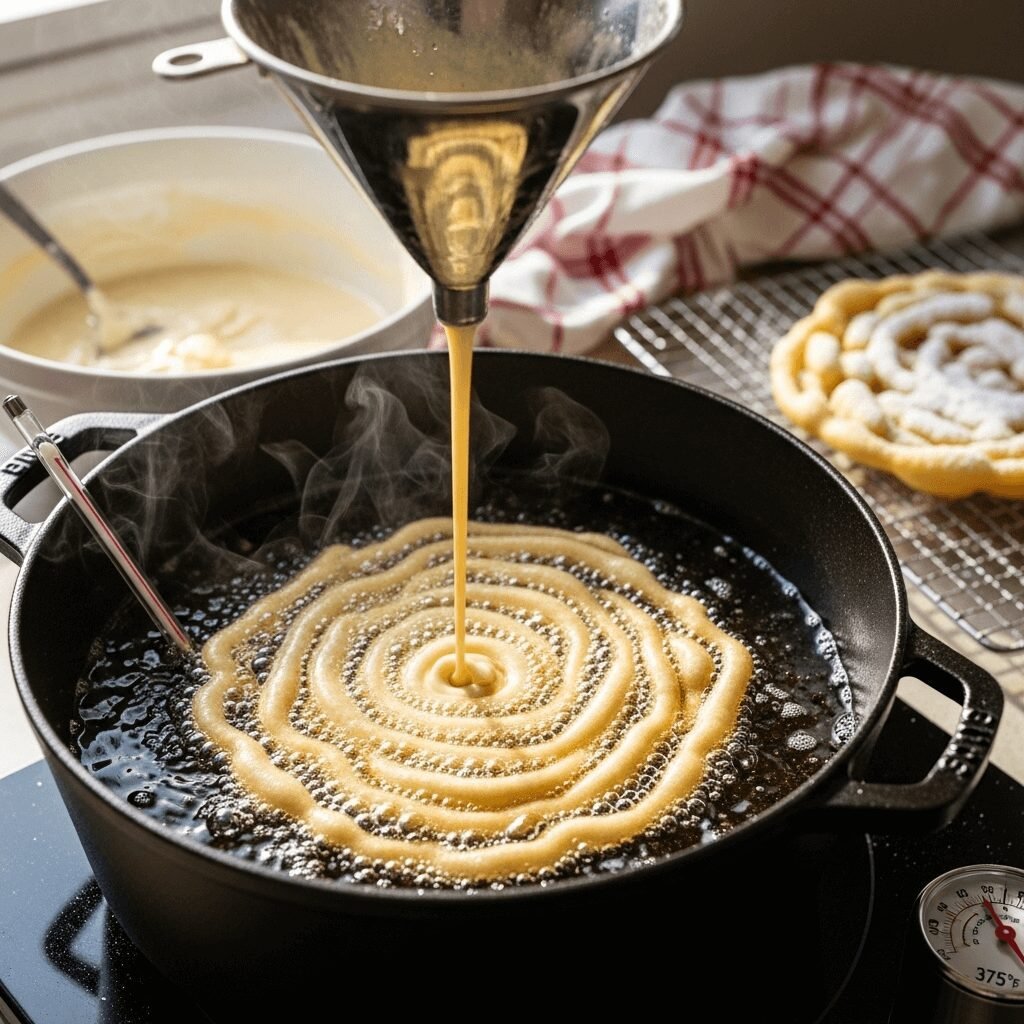
- Funnel or Squeeze Bottle – A wide-mouth funnel (with at least a ½-inch opening) is traditional, or use a plastic squeeze bottle with the tip cut to create a larger opening. Some people use a zipper-lock bag with a corner cut off
- Candy Thermometer or Deep-Fry Thermometer – Crucial for maintaining the correct oil temperature (375°F). This is the difference between perfectly cooked and greasy funnel cakes
- Large Mixing Bowl – For combining your batter ingredients
- Whisk – To mix the batter until smooth
- Measuring Cups and Spoons – Accurate measurements ensure consistent results
- Slotted Spoon or Spider Strainer – For safely removing the funnel cakes from the hot oil
- Paper Towels and Wire Rack – For draining excess oil after frying
- Fine Mesh Sieve or Flour Sifter – For dusting powdered sugar evenly over the finished funnel cakes
- Long Tongs – Optional but helpful for flipping or adjusting funnel cakes while frying
- Heat-Resistant Measuring Cup – Useful if using a squeeze bottle method
Easy Homemade Funnel Cake Recipe – Crispy, Golden & Carnival-Perfect!
Crispy, golden homemade funnel cakes that taste just like the ones at the county fair! This easy recipe uses simple ingredients and creates perfectly twisted, lacy funnel cakes with crispy edges and fluffy centers. Dust with powdered sugar or load them up with your favorite toppings for the ultimate carnival treat at home!
- Prep Time: 10 minutes
- Cook Time: 15 minutes (about 2 minutes per funnel cake)
- Total Time: 25 minutes
- Yield: 6-8 funnel cakes 1x
- Category: Dessert
- Method: Deep Frying
- Cuisine: American
- Diet: Vegetarian
Ingredients
For the Funnel Cakes:
- 2 cups all-purpose flour
- 2 tablespoons granulated sugar
- 1 teaspoon baking powder
- ½ teaspoon salt
- 2 large eggs
- 1½ cups whole milk
- 1 teaspoon vanilla extract
- Vegetable oil for frying (about 6-8 cups, depending on pot size)
For Topping:
- ½ cup powdered sugar (or more to taste)
- Optional toppings: fresh berries, chocolate sauce, whipped cream, fruit preserves, cinnamon sugar
Instructions
- Prepare Your Workspace: Set up a draining station with a wire rack placed over a baking sheet lined with paper towels. Have your funnel or squeeze bottle ready. Fill a fine mesh sieve with powdered sugar for dusting.
- Make the Batter: In a large mixing bowl, whisk together the flour, granulated sugar, baking powder, and salt until well combined. Create a well in the center of the dry ingredients.
- Add Wet Ingredients: In a separate bowl or large measuring cup, whisk together the eggs, milk, and vanilla extract until smooth. Pour the wet ingredients into the well of the dry ingredients.
- Mix Until Smooth: Whisk the batter until completely smooth with no lumps remaining. The consistency should be similar to pancake batter—thick enough to coat the back of a spoon but thin enough to pour easily through your funnel. If it’s too thick, add a tablespoon or two of milk. If too thin, add a bit more flour.
- Heat the Oil: Pour vegetable oil into your large pot to a depth of 2-3 inches. Heat over medium-high heat until the oil reaches 375°F on a candy thermometer. This temperature is critical—too cool and your funnel cakes will be greasy; too hot and they’ll burn before cooking through.
- Test the Oil: To test if the oil is ready without a thermometer, drop a small bit of batter into the oil. It should sizzle immediately and begin to turn golden within about 30 seconds.
- Prepare Your Funnel: Pour about ¾ cup of batter into your funnel or squeeze bottle. If using a funnel, hold your finger over the bottom opening to keep the batter from flowing out until you’re ready.
- Fry the First Funnel Cake: Hold the funnel or squeeze bottle about 6 inches above the hot oil. Release the batter, moving your hand in a circular, swirling motion to create a spiral or zigzag pattern. Work from the center outward, creating overlapping swirls. The funnel cake should be about 6-8 inches in diameter. Don’t worry about making it perfect—the irregular, lacy pattern is part of the charm!
- Cook the First Side: Let the funnel cake fry for about 1 minute, or until the bottom is golden brown and crispy. You’ll see the edges turning golden and the top will start to look less wet.
- Flip and Finish: Using a slotted spoon or spider strainer, carefully flip the funnel cake over. Fry for another 45 seconds to 1 minute, until both sides are deep golden brown and crispy.
- Drain: Remove the funnel cake from the oil, allowing excess oil to drip off, then place it on your prepared wire rack to drain. The wire rack is important—it allows air circulation so the bottom doesn’t get soggy.
- Repeat: Continue making funnel cakes with the remaining batter, allowing the oil to return to 375°F between batches. Don’t overcrowd the pot—fry one at a time for best results.
- Top and Serve: While still warm, generously dust each funnel cake with powdered sugar using your mesh sieve. Add any additional toppings you desire. Serve immediately while still warm and crispy!
Notes
- Oil Temperature is Key: Maintaining 375°F is crucial. If the oil gets too hot, reduce heat slightly. If too cool, increase heat and wait before adding more batter.
- Batter Consistency: The batter should flow easily but not be watery. Think slightly thinner than pancake batter. Adjust with small amounts of milk or flour as needed.
- Funnel Alternatives: If you don’t have a funnel, a squeeze bottle (like a condiment bottle) works great. You can also use a heavy-duty zipper-lock bag with a ½-inch corner cut off, though this can be messier.
- Practice Makes Perfect: Your first funnel cake might not be picture-perfect, and that’s okay! By the second or third one, you’ll get the hang of the swirling motion.
- Safety First: Always be careful when working with hot oil. Use long utensils, never leave hot oil unattended, and keep children and pets away from the cooking area.
- Serving Size: One funnel cake per person is typically enough, though some people with big appetites might want two!
Nutrition
- Serving Size: 1 funnel cake (without additional toppings)
- Calories: 285
- Sugar: 8g
- Sodium: 245mg
- Fat: 12g
- Saturated Fat: 2g
- Unsaturated Fat: 9g
- Trans Fat: 0g
- Carbohydrates: 37g
- Fiber: 1g
- Protein: 7g
- Cholesterol: 55mg
Tips & Variations
One of the best things about funnel cakes is how versatile they are! Here are some creative ways to customize this recipe and make it your own:
Chocolate Funnel Cakes: Add 3 tablespoons of cocoa powder to the dry ingredients and increase the sugar by 1 tablespoon. Drizzle with chocolate sauce and top with whipped cream for a decadent treat.
Cinnamon Sugar Topping: Mix ½ cup granulated sugar with 2 teaspoons cinnamon and sprinkle over the warm funnel cakes instead of powdered sugar. This gives them a churro-like flavor!
Strawberry Shortcake Style: Top with fresh sliced strawberries, whipped cream, and a drizzle of strawberry sauce for an elegant dessert presentation.
Apple Pie Funnel Cake: Top with warm cinnamon apples (like pie filling), vanilla ice cream, and caramel sauce for a fall-inspired version.
S’mores Funnel Cake: Top with chocolate sauce, mini marshmallows, and crushed graham crackers, then use a kitchen torch to toast the marshmallows.
Lemon Blueberry: Add 1 tablespoon of lemon zest to the batter and top with fresh blueberries, lemon glaze, and whipped cream.
Maple Bacon: Drizzle with warm maple syrup and sprinkle with crispy bacon crumbles for a sweet-and-savory combination.
Mini Funnel Cakes: Make smaller 3-4 inch versions for bite-sized treats perfect for parties. They’ll cook faster—about 45 seconds per side.
Gluten-Free Version: Use a 1:1 gluten-free flour blend with xanthan gum. The texture will be slightly different but still delicious.
Pro Chef Tips
These professional insights will help you achieve perfect, carnival-quality funnel cakes every single time:
Master Your Oil Temperature: This is the single most important factor. Use a thermometer and check frequently. If you notice the funnel cakes browning too quickly or staying pale, adjust your heat accordingly. The oil temperature will drop when you add batter, so you may need to increase heat slightly between batches.
The Right Batter Thickness: Your batter should coat the back of a spoon but drip off in a steady stream. Too thick and it won’t flow properly through your funnel; too thin and it won’t hold its shape. Test by pouring a small amount—it should flow smoothly but not spread out immediately when it hits the oil.
Control Your Pour: Start in the center and work outward with confident, flowing movements. Don’t move too slowly or the batter will create thick spots that won’t cook evenly. Think of creating a loose spiral or random squiggles that overlap—there’s no wrong pattern!
Don’t Overcrowd the Layers: When making your swirl pattern, overlapping is good, but piling batter too thick in one spot creates dense, undercooked areas. Aim for a relatively even distribution with some thin, crispy edges.
The Flip Timing is Critical: Wait until you see the edges turn golden and the top surface looks mostly set before flipping. If you flip too early, the funnel cake can break apart. A perfectly timed flip happens when the bottom is golden and crispy but the top is just barely set.
Fresh Oil Makes a Difference: If you’re making multiple batches for a party, consider changing the oil after every 8-10 funnel cakes. Old oil that’s filled with browned bits affects the flavor and color of your funnel cakes.
Serve Immediately: Funnel cakes are at their absolute best within the first 5-10 minutes after frying. The contrast between the crispy exterior and soft interior is peak perfection when they’re fresh and warm.
Double-Dredge for Extra Crispiness: For super crispy funnel cakes, let the first side get extra golden (about 75-90 seconds) before flipping. This creates more of those delicious crispy bits.
Common Mistakes to Avoid
Even though funnel cakes are relatively simple, there are a few common pitfalls that can affect your results. Here’s how to avoid them:
Using the Wrong Oil Temperature: This is the biggest mistake. Oil that’s too cool (below 350°F) makes greasy, soggy funnel cakes that absorb too much oil. Oil that’s too hot (above 385°F) burns the outside before the inside cooks through. Always use a thermometer and maintain 375°F for perfect results.
Making the Batter Too Thick or Thin: Batter consistency directly affects how your funnel cake forms and cooks. If it’s too thick, it won’t flow through the funnel properly and will create dense, doughy spots. If too thin, it will spread out too much in the oil and won’t hold together. The batter should flow in a steady stream but hold its shape once it hits the oil.
Pouring Too Much Batter at Once: It’s tempting to make huge funnel cakes, but oversized ones are difficult to flip without breaking and hard to cook evenly. Stick to 6-8 inch diameter cakes using about ¾ cup of batter. Multiple smaller ones are better than one giant unmanageable cake.
Not Letting Oil Return to Temperature: After frying each funnel cake, the oil temperature drops. If you immediately add more batter without waiting, the next funnel cake will be greasy and undercooked. Wait 1-2 minutes between batches for the oil to reheat to 375°F.
Crowding the Pattern Too Much: While you want overlapping swirls, piling too much batter in the center or making it too thick prevents even cooking. You’ll end up with raw spots in thick areas and burnt edges. Aim for a relatively even thickness throughout with intentional thin, crispy sections.
Flipping Too Early or Too Late: Flip too soon and your funnel cake falls apart; flip too late and the bottom burns. Look for golden-brown edges and a surface that’s mostly set but slightly glossy. This usually happens around the 60-second mark.
Draining on Paper Towels Only: If you place hot funnel cakes directly on paper towels without a wire rack, the bottom becomes soggy from trapped steam and oil. Always use a wire rack for proper drainage and air circulation.
Storage & Meal Prep
While funnel cakes are definitely best enjoyed fresh and hot, here’s how to handle leftovers and plan ahead:
Room Temperature Storage: Leftover funnel cakes can be stored at room temperature in an airtight container for up to 2 days. Place parchment paper between layers to prevent sticking. However, they will lose their crispiness and become more cake-like in texture.
Refrigerator Storage: You can refrigerate leftover funnel cakes for up to 3 days in an airtight container. Again, they won’t be as crispy, but they’re still tasty. The cold actually makes them firmer and more cake-like.
Reheating for Best Results: To restore some of the original texture, reheat funnel cakes in a 350°F oven for 5-7 minutes, or in an air fryer at 350°F for 3-4 minutes. This crisps them up much better than microwaving, which makes them soggy and chewy.
Microwave Reheating (Quick Method): If you’re in a hurry, microwave for 15-20 seconds. The texture won’t be as good, but it will be warm and edible.
Serving Leftovers Creatively: Turn day-old funnel cakes into dessert “bread pudding” by tearing them into pieces, soaking in an egg-milk custard mixture, and baking. They also work as a base for ice cream sundaes.
Make-Ahead & Freezer Notes
If you’re planning a party or just want to prep ahead, here’s what you need to know:
Make the Batter Ahead: You can prepare the funnel cake batter up to 4 hours in advance and store it covered in the refrigerator. Give it a good stir before using, and you may need to thin it slightly with a tablespoon or two of milk, as it thickens when cold.
Freezing Cooked Funnel Cakes: Yes, you can freeze cooked funnel cakes! Let them cool completely, then freeze in a single layer on a baking sheet until solid (about 2 hours). Transfer to a freezer bag with parchment paper between layers. They’ll keep for up to 2 months.
Thawing and Reheating Frozen Funnel Cakes: Remove from the freezer and let thaw at room temperature for about 30 minutes. Then reheat in a 350°F oven for 7-10 minutes, or in an air fryer at 350°F for 5-6 minutes. This method brings back much of the original crispiness.
Freezing Raw Batter: I don’t recommend freezing the batter itself, as the baking powder can lose effectiveness, resulting in less fluffy funnel cakes.
Best Practice for Parties: If you’re hosting an event, set up your frying station right before guests arrive and make the funnel cakes fresh. They only take 2 minutes each to cook, so you can fry them to order. Alternatively, make them up to 1 hour ahead, keep warm in a 200°F oven, and refresh them briefly at 350°F right before serving.
Topping Tips: Always add powdered sugar and fresh toppings just before serving, never ahead of time. The sugar will absorb moisture and the fresh toppings will make the funnel cakes soggy if added too early.
Serving Suggestions
Funnel cakes are versatile and can be served in so many delicious ways. Here are some ideas to inspire you:
Classic Fair Style: Simply dust with powdered sugar and serve immediately—sometimes the simplest version is the best! Serve with paper napkins for authentic carnival vibes.
Ice Cream Sundae Base: Place a funnel cake on a plate and top with a scoop or two of vanilla, strawberry, or chocolate ice cream, then add your favorite sundae toppings—hot fudge, caramel, whipped cream, cherries, and sprinkles.
Fresh Fruit Topping: Top with fresh strawberries, blueberries, raspberries, or sliced peaches. Add whipped cream and a light drizzle of fruit syrup for a refreshing summer dessert.
Nutella and Banana: Spread warm Nutella over the funnel cake and top with sliced bananas and a sprinkle of chopped hazelnuts. Drizzle with chocolate sauce for extra indulgence.
Beverage Pairings: Serve with ice-cold lemonade, iced tea, hot chocolate, or coffee. For adults, pair with dessert wine or even a chocolate stout beer.
Party Dessert Bar: Set up a funnel cake topping station with bowls of various toppings—powdered sugar, cinnamon sugar, chocolate chips, crushed cookies, candy pieces, fruit sauces, whipped cream, and sprinkles. Let guests customize their own!
Breakfast Version: Serve funnel cakes for breakfast or brunch topped with maple syrup, fresh berries, and a dollop of Greek yogurt for a special-occasion morning treat.
Savory Twist (Unconventional but Delicious): Omit the vanilla and reduce sugar to 1 tablespoon in the batter. Top with fried chicken and honey for a fun take on chicken and waffles!
FAQs Section
Can I make funnel cakes without a funnel?
Absolutely! A squeeze bottle (like those used for ketchup or mustard) works wonderfully—just cut the tip to create a larger opening. You can also use a heavy-duty freezer bag with a corner cut off, though this can be messier. Some people even use a ladle or measuring cup and pour in a drizzling motion, though this requires more practice to control the flow.
Why are my funnel cakes greasy?
The oil temperature is likely too low. When oil isn’t hot enough (below 350°F), the batter absorbs excess oil instead of quickly crisping up. Always use a thermometer and maintain 375°F. Also, make sure to drain funnel cakes properly on a wire rack, not just paper towels.
Can I use a different type of milk?
Yes! Whole milk gives the richest flavor and best texture, but 2% milk works well too. Buttermilk creates a slightly tangier, more tender funnel cake. You can even use non-dairy milk like almond or oat milk, though the flavor will be slightly different. Avoid skim milk as it’s too thin and won’t create the right texture.
Why did my funnel cake fall apart?
This usually happens for one of three reasons: the batter was too thin (add a bit more flour), the oil wasn’t hot enough (increase temperature to 375°F), or you tried to flip it too early before the first side was properly set. Wait until you see golden edges and the top looks mostly set before flipping.
How do I know when the oil is hot enough without a thermometer?
Drop a small bit of batter into the oil. If it sizzles immediately and starts turning golden within 30-45 seconds, your oil is ready. If it sinks to the bottom or browns too quickly (within 15 seconds), adjust accordingly. However, I strongly recommend investing in a candy thermometer—they’re inexpensive and make consistent results so much easier.
Can I bake funnel cakes instead of frying them?
Unfortunately, no. The frying process is what creates that distinctive crispy exterior and fluffy interior. Baking won’t give you the same texture or flavor. If you’re concerned about deep frying, you might enjoy baked churros or elephant ears as alternatives, but they won’t be true funnel cakes.
What’s the best oil to use for frying?
Vegetable oil, canola oil, and peanut oil all work excellently because they have high smoke points and neutral flavors. Avoid oils with low smoke points (like olive oil) or strong flavors (like coconut oil) which will affect the taste of your funnel cakes.
Conclusion
There you have it—everything you need to make perfect, carnival-quality funnel cakes right in your own kitchen! This recipe brings all the fun, flavor, and nostalgia of the fair straight to your home, and I guarantee it’ll become one of your most requested treats.
The beauty of homemade funnel cakes is that they’re so much more affordable than buying them at the fair, and you can make them anytime the craving hits. Whether it’s a special occasion, a weekend treat for the family, or just because you deserve something delicious, these funnel cakes deliver pure happiness on a plate.
Don’t be intimidated by the frying process—after your first one or two, you’ll be swirling that batter like a pro! And the look on your family’s or guests’ faces when you serve warm, crispy, sugar-dusted funnel cakes? Absolutely priceless. You’ll feel like you’ve brought the carnival home, complete with all the joy and excitement (minus the crowds and ticket prices!).
Now it’s your turn to make some funnel cake magic! I’d love to hear how yours turn out. Did you try any fun toppings? Did your kids get involved in the decorating? Share your experience in the comments below, and don’t forget to pin this recipe to your Pinterest boards so you can find it easily next time. Tag me in your funnel cake photos—I love seeing your creations!
Happy frying, and enjoy every crispy, sweet, carnival-perfect bite! 🎡✨