Perfect Creamy Flan Recipe – Classic Caramel Custard Dessert!

Flan is one of those magical desserts that looks incredibly elegant but is surprisingly simple to make at home. This silky-smooth caramel custard features a rich, creamy texture that melts on your tongue, topped with a gorgeous golden caramel sauce that pools around each slice. It’s the kind of dessert that makes people think you spent hours in the kitchen, when really, it comes together in about 20 minutes of active prep time.
Also known as crème caramel in France or flan de leche in Latin America, this classic baked custard has been delighting diners for centuries. The combination of eggs, milk, sugar, and vanilla creates an incredibly luscious texture, while the homemade caramel adds a beautiful bittersweet complexity that balances the custard’s sweetness perfectly. Serve this show-stopping dessert at dinner parties, holiday gatherings, special celebrations, or anytime you want to impress your guests with minimal effort. It’s naturally gluten-free, can be made a day ahead, and looks absolutely stunning when unmolded onto a serving plate with that gorgeous caramel cascade!
History / Background
Flan’s history stretches back to ancient Rome, where the Romans were among the first to domesticate chickens and suddenly had an abundance of eggs. They created sweet and savory custards, cooking them over open flames in earthenware dishes. The Latin word “flado,” meaning flat cake, eventually evolved into the Spanish “flan” we know today.
When the Roman Empire expanded across Europe, they brought their custard-making techniques with them. Different regions adapted the recipe to their local tastes and ingredients, which is why you’ll find variations across Spain, France, Portugal, and Italy. The Spanish version became particularly refined during the Middle Ages, when Arab influences introduced new spice combinations and cooking techniques to the Iberian Peninsula.
The Spanish conquistadors brought flan to the Americas in the 1500s, where it was embraced enthusiastically throughout Latin America and the Caribbean. Each country developed its own signature style—Mexican flan often includes evaporated and condensed milk for extra richness, Cuban flan sometimes features cream cheese, Filipino leche flan uses more egg yolks for a denser texture, and Brazilian pudim de leite condensado relies heavily on sweetened condensed milk.
In the United States, flan gained popularity in the mid-20th century as Latin American cuisine became more mainstream. Today, it’s a staple dessert in Mexican, Spanish, and Latin American restaurants across the country, beloved for its sophisticated simplicity and that dramatic moment when you flip it over to reveal the caramel-coated perfection underneath.
What makes flan so enduring is its versatility and accessibility. Whether you’re in a rustic kitchen in rural Mexico or a modern apartment in New York City, you can create this elegant dessert with just a handful of basic ingredients. It represents centuries of culinary tradition while remaining completely relevant to modern home cooks who appreciate desserts that are both impressive and achievable.
Why You’ll Love This Recipe
This classic flan recipe delivers restaurant-quality results with straightforward techniques that even beginners can master. The custard sets beautifully every time, and the homemade caramel creates that signature glossy coating that makes flan so irresistible.
Here’s why this recipe will become your go-to elegant dessert:
- Surprisingly easy – Despite its fancy appearance, flan requires just basic mixing and baking skills
- Make-ahead friendly – Actually tastes better when made a day in advance, perfect for entertaining
- Naturally gluten-free – No special substitutions needed, making it accessible for most dietary needs
- Budget-friendly – Uses simple pantry staples like eggs, milk, and sugar
- Impressive presentation – Looks like it came from a high-end restaurant when unmolded
- Silky texture – That signature smooth, creamy custard that melts in your mouth
- Not overly sweet – The slightly bitter caramel balances the custard perfectly
- Serves a crowd – One recipe makes 6-8 generous portions
- Customizable – Easy to add flavors like coffee, coconut, or citrus
- Foolproof water bath method – Ensures even, gentle cooking for perfect texture every time
- Crowd-pleaser – Appeals to all ages and is familiar enough to comfort while feeling special
Ingredient Notes
Understanding your ingredients is key to making perfect flan. Here’s what you need and why each component matters:
Granulated Sugar (for caramel) – This creates the beautiful amber caramel coating that gives flan its signature look and flavor. White granulated sugar works best because it caramelizes evenly and creates that clear, golden color. Don’t substitute with brown sugar for the caramel as it won’t set properly and the color will be muddy. You’ll need to watch it carefully as it melts—it goes from perfect to burnt quickly!
Large Eggs – The foundation of your custard, eggs provide structure and that signature silky texture. Use large eggs at room temperature for best results, as they incorporate more smoothly into the milk mixture. Each egg should weigh about 50g without the shell. The eggs need to be whisked gently (not beaten vigorously) to avoid incorporating too much air, which creates bubbles in the finished flan.
Whole Milk – Creates the base of your custard with a rich, creamy flavor. Whole milk (3.25% fat) provides the best texture—2% milk can be used but results in a slightly less creamy flan. Avoid skim milk as the custard won’t be rich enough. For an even more decadent flan, you can substitute up to half the milk with heavy cream or evaporated milk.
Granulated Sugar (for custard) – Sweetens the custard and helps it set properly. The amount listed creates a moderately sweet dessert that’s balanced by the caramel. If you prefer less sweet desserts, you can reduce this by 2-3 tablespoons, though it may affect the texture slightly.
Pure Vanilla Extract – Essential for that classic flan flavor! Use real vanilla extract, not imitation, as the flavor difference is noticeable in such a simple dessert. Mexican vanilla extract is particularly wonderful if you can find it, as it has a slightly more complex, creamy flavor profile. Vanilla bean paste or the seeds from one vanilla bean can be substituted for an even more luxurious touch.
Salt – Just a pinch enhances all the other flavors and prevents the custard from tasting flat. Don’t skip it even though it seems like a tiny amount—it makes a significant difference in the final taste.
Optional: Evaporated Milk – Many traditional Latin American flan recipes use half whole milk and half evaporated milk for extra richness and a slightly caramelized flavor. Evaporated milk is simply milk with about 60% of the water removed, making it thicker and more concentrated. If using evaporated milk, replace 1½ cups of the whole milk with 1½ cups of evaporated milk.
Optional: Sweetened Condensed Milk – For a richer, denser flan, you can add ½ cup sweetened condensed milk and reduce the sugar in the custard by ¼ cup. This creates a more decadent, almost candy-like texture that some people prefer.
Equipment Needed
Flan requires some specific equipment for best results. Here’s what you’ll need:
- Round cake pan or flan mold (8 or 9-inch) – A metal or glass round pan works perfectly for flan. Avoid non-stick pans for making the caramel as it’s harder to monitor the color
- Large roasting pan – For the water bath (bain-marie) that ensures gentle, even cooking
- Medium saucepan – For making the caramel
- Large mixing bowl – For combining the custard ingredients
- Whisk – For gently mixing the custard (not beating it)
- Fine-mesh strainer – Essential for removing any egg solids or lumps for silky-smooth custard
- Measuring cups and spoons – For accurate measurements
- Kettle or pot for boiling water – For the water bath
- Oven mitts – For safely handling hot water bath
- Offset spatula or butter knife – For loosening the flan before unmolding
- Serving plate with a rim – To catch all that beautiful caramel when you flip it
- Aluminum foil – To cover the pan during baking and prevent skin formation
Perfect Creamy Flan Recipe – Classic Caramel Custard Dessert!

This classic flan recipe creates a perfectly smooth, creamy caramel custard with a gorgeous homemade caramel sauce. Easy to make with simple ingredients, it’s an elegant make-ahead dessert that’s naturally gluten-free and always impresses!
- Prep Time: 55-65 minutes
- Cook Time: 4 hours (or overnight)
- Total Time: 5 hours 20 minutes
- Yield: 8 servings 1x
- Category: Dessert
- Method: Baking (water bath)
- Cuisine: Latin American/Spanish
- Diet: Vegetarian
Ingredients
For the Caramel:
- 1 cup granulated sugar
- ¼ cup water
For the Custard:
- 5 large eggs
- 1 (14 oz) can sweetened condensed milk
- 1 (12 oz) can evaporated milk
- 1 cup whole milk
- 1 tablespoon pure vanilla extract
- ¼ teaspoon salt
Instructions
- Preheat oven and prepare water bath: Preheat your oven to 350°F (175°C). Place a kettle of water on to boil for the water bath. Have your 8 or 9-inch round cake pan ready.
- Make the caramel: In a medium saucepan over medium heat, combine 1 cup sugar and ¼ cup water. Stir gently until the sugar dissolves, then stop stirring. Let the mixture cook undisturbed, swirling the pan occasionally, for 8-12 minutes until it turns a deep amber color (like the color of an old penny). Watch carefully during the last few minutes as it can burn quickly.
- Coat the pan: Immediately and carefully pour the hot caramel into your round cake pan. Quickly tilt and swirl the pan to coat the bottom and about 1 inch up the sides. The caramel will harden as it cools—this is normal. Set aside.
- Blend the custard: In a large bowl, whisk the eggs gently until just combined—don’t beat vigorously or you’ll incorporate too much air. Add the sweetened condensed milk, evaporated milk, whole milk, vanilla extract, and salt. Whisk gently until completely smooth and combined.
- Strain the custard: Pour the custard mixture through a fine-mesh strainer into the caramel-lined pan. This removes any egg solids or bubbles for an ultra-smooth texture. Use a spoon to skim off any remaining bubbles on the surface.
- Prepare the water bath: Place the flan pan inside a larger roasting pan. Carefully pour the hot water from your kettle into the roasting pan (not into the flan!) until it comes about halfway up the sides of the flan pan. This water bath ensures gentle, even cooking.
- Bake: Cover the roasting pan loosely with aluminum foil. Carefully transfer to the oven and bake for 55-65 minutes. The flan is done when it’s set around the edges but still has a slight jiggle in the center (about a 2-inch circle of wobble). It will continue to set as it cools. A knife inserted near the edge should come out clean.
- Cool completely: Carefully remove the flan pan from the water bath using oven mitts. Let it cool to room temperature on a wire rack (about 1 hour), then cover with plastic wrap and refrigerate for at least 4 hours, or preferably overnight. The flan must be completely cold before unmolding.
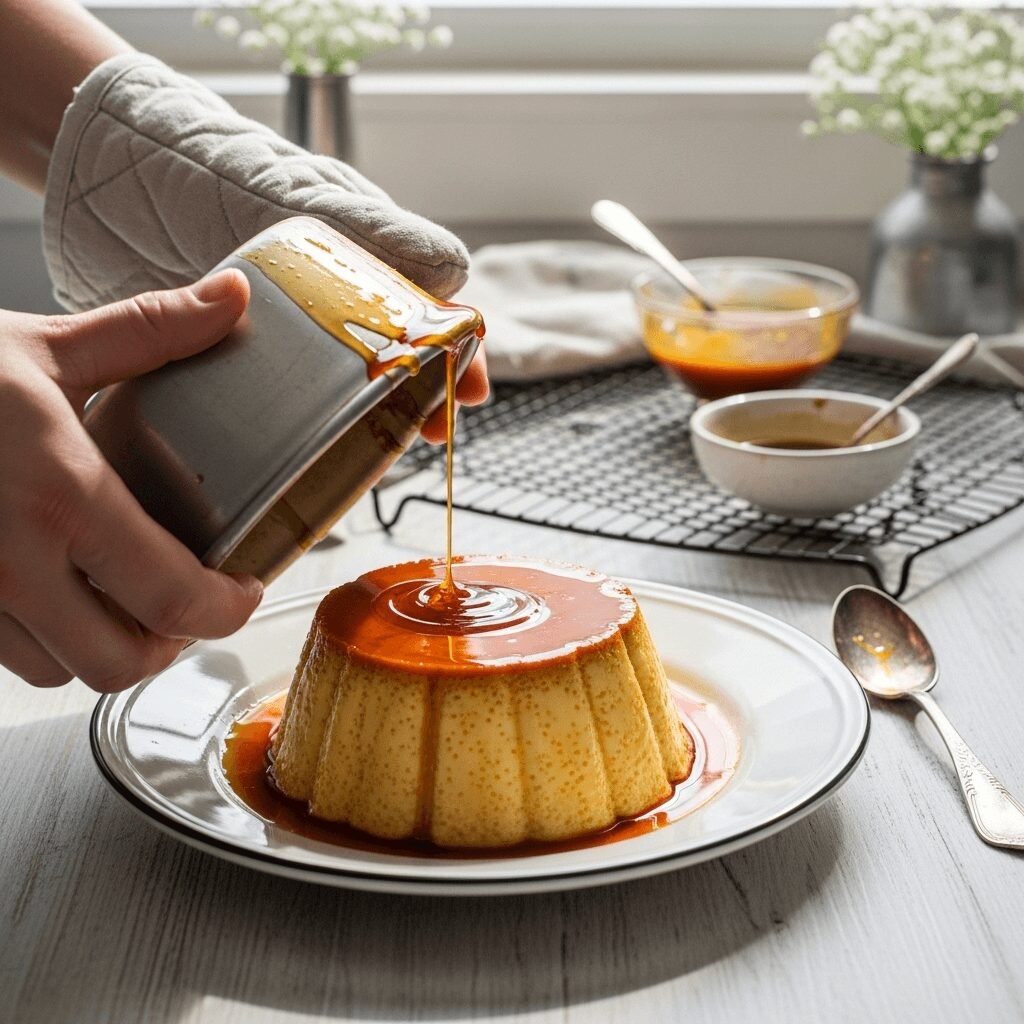
- Unmold and serve: When ready to serve, run a thin knife or offset spatula around the edge of the pan to loosen the flan. Place a serving plate with a rim upside down on top of the pan. Holding both the plate and pan firmly, quickly flip them over together. Give the pan a gentle shake—the flan should release with all that beautiful caramel sauce. If it doesn’t release immediately, let gravity do its work for 30 seconds, or carefully lift one edge of the pan and slide a spoon under to help release it.
- Serve: Slice with a sharp knife (wiping the blade between cuts for clean slices) and serve each piece with plenty of that gorgeous caramel sauce spooned over top.
Notes
- Caramel safety: The caramel is extremely hot and will continue to bubble even after you pour it. Handle with care and keep children away during this step.
- Water bath temperature: Make sure your water is hot (not lukewarm) when you add it to the roasting pan for even cooking.
- Doneness test: The center should jiggle like soft Jell-O when you gently shake the pan. It will firm up as it cools. Overbaking creates a grainy texture.
- Make-ahead: Flan actually improves after 24 hours in the refrigerator as the flavors meld and the texture becomes even creamier.
- Stuck caramel: If caramel hardens in your pan before you can swirl it, briefly place the pan over low heat to re-melt it.
- Altitude adjustments: At high altitudes, you may need to increase baking time by 10-15 minutes.
Nutrition
- Serving Size: 1 slice (1/8 of flan)
- Calories: 295
- Sugar: 42g
- Sodium: 150mg
- Fat: 8g
- Saturated Fat: 4g
- Unsaturated Fat: 3g
- Trans Fat: 0g
- Carbohydrates: 47g
- Fiber: 0g
- Protein: 9g
- Cholesterol: 135mg
Nutrition information is approximate and will vary based on specific ingredients and portion sizes.
Tips & Variations
The basic flan recipe is wonderfully versatile! Here are creative ways to customize it:
Flavor Variations:
- Coffee Flan: Add 2 tablespoons instant espresso powder dissolved in the milk for a sophisticated café con leche flavor
- Coconut Flan: Replace 1 cup of the milk with coconut milk and add ½ cup sweetened shredded coconut to the custard
- Cream Cheese Flan: Blend in 8 oz softened cream cheese for an ultra-rich, cheesecake-like texture
- Citrus Flan: Add 2 tablespoons orange or lime zest to the custard for a bright, refreshing twist
- Chocolate Flan (Chocoflan): Add ¼ cup cocoa powder to half the custard for a marbled effect
- Dulce de Leche Flan: Swirl 3 tablespoons dulce de leche through the custard before baking
- Pumpkin Flan: Add ¾ cup pumpkin puree and 1 teaspoon pumpkin pie spice for a fall-inspired version
Presentation Variations:
- Individual Flans: Divide among 6-8 ramekins and reduce baking time to 35-40 minutes
- Flan Cake: Pour chocolate cake batter over the custard before baking for the famous “impossible cake”
- Layered Flan: Create a two-tone effect with coffee custard on the bottom and vanilla on top
Dietary Modifications:
- Dairy-Free: Use coconut milk and coconut cream in place of dairy milks (texture will be slightly different)
- Lower Sugar: Reduce the sugar in the custard by up to ¼ cup, though it affects texture slightly
- Egg-Free: Not recommended as eggs provide the structure—there’s no good substitute for flan
Caramel Variations:
- Salted Caramel: Sprinkle flaky sea salt over the caramel before adding the custard
- Bourbon Caramel: Add 1 tablespoon bourbon to the caramel (be careful as it will bubble vigorously)
- Honey Caramel: Replace half the sugar with honey for a floral note
Pro Chef Tips
Take your flan from good to absolutely spectacular with these professional techniques:
Room Temperature Ingredients Are Key – Let your eggs and milk sit at room temperature for 30 minutes before starting. Cold ingredients don’t blend as smoothly and can cause the caramel to seize when you pour the custard over it. Room temperature ingredients also bake more evenly.
Don’t Rush the Caramel – Patience is everything when making caramel. Medium heat is your friend—high heat will burn the sugar before it fully caramelizes. Once the sugar dissolves, resist the urge to stir. Swirling the pan is enough. Watch for that perfect amber color—it should smell nutty and rich, not burnt.
Strain Twice If Needed – For the silkiest possible texture, strain your custard mixture twice. This removes any chalazae (those white stringy bits from the eggs) and ensures no lumps make it into your flan. It’s worth the extra dish!
The Water Bath Is Non-Negotiable – Never skip the bain-marie (water bath). It provides gentle, even heat that prevents the edges from overcooking while the center is still raw. It also prevents curdling and ensures that creamy texture. The water should come at least halfway up the sides of your flan pan.
Underbake Slightly – The center should still have a gentle jiggle about 2 inches in diameter when you remove it from the oven. It will continue cooking from residual heat and will set completely as it cools. Overbaked flan has a grainy, curdled texture instead of that signature silky smoothness.
Patience With Cooling – Don’t rush the cooling and chilling process. Flan needs to be completely cold before unmolding or it will fall apart. Overnight chilling is ideal as it allows the custard to fully set and the flavors to develop beautifully.
The Flip Technique – When unmolding, confidence is key! Use a plate with a rim to catch all the caramel sauce, make sure your knife has released the edges completely, then flip quickly and decisively. If you hesitate, you’re more likely to have problems. Let gravity help—once flipped, let it sit for 30 seconds before lifting the pan.
Warm the Pan for Easy Release – If your flan is stubborn about releasing, set the bottom of the pan in a shallow dish of hot water for 30-60 seconds. This slightly melts the caramel and helps it release easily.
Common Mistakes to Avoid
Even experienced bakers can stumble with flan! Here’s how to sidestep the most common issues:
Burning the Caramel – This is the number one mistake! Caramel goes from perfect amber to burnt in seconds. Watch it carefully once it starts to color, and remove it from heat immediately when it reaches that rich golden-brown color (like an old penny or strong tea). Burnt caramel tastes acrid and bitter—there’s no fixing it, you’ll have to start over. Use medium heat and patience.
Beating the Eggs Too Vigorously – Whisking the eggs aggressively incorporates air bubbles that will create holes and an uneven texture in your finished flan. Whisk gently just until the eggs are combined—you’re not making a meringue! Those bubbles won’t disappear during baking and will leave your flan looking pockmarked instead of smooth.
Skipping the Straining Step – It might seem like an extra hassle, but straining removes egg solids, chalazae, and any small lumps that will ruin the silky texture. This single step is the difference between restaurant-quality smooth flan and home-cooking grainy flan. Always strain!
Getting Water in the Custard – If water from the bain-marie gets into your flan, it’s ruined. Make sure your roasting pan is stable and won’t tip. When covering with foil, be careful it doesn’t trap condensation that might drip in. Some bakers wrap the outside of the flan pan with aluminum foil as insurance against water seepage.
Overbaking – When flan is overbaked, the proteins in the eggs tighten too much and squeeze out liquid, creating a grainy, curdled texture with visible holes. It should still jiggle in the center when you remove it—trust the jiggle! It will set completely as it cools. Use an oven thermometer to ensure your oven temperature is accurate.
Unmolding While Still Warm – Warm flan will collapse or fall apart when unmolded. The custard needs to be completely chilled and set before you attempt to flip it. Four hours minimum, but overnight is truly better. Be patient!
Storage & Meal Prep
Proper storage keeps your flan perfect for several days:
Refrigerator Storage: Flan must be kept refrigerated at all times due to the eggs and dairy. If unmolded, cover loosely with plastic wrap or place under a cake dome to prevent it from absorbing refrigerator odors. If still in the pan, cover tightly with plastic wrap. Properly stored, flan will last 4-5 days in the refrigerator.
Caramel Sauce: The caramel sauce will pool around the flan and can be spooned over each serving. If the caramel seems to have thickened too much in the refrigerator, let the flan sit at room temperature for 15-20 minutes before serving, or very gently warm the serving plate.
Storage in the Baking Pan: Many people prefer to store flan right in the baking pan and unmold it just before serving. This works perfectly—just cover the pan tightly with plastic wrap and refrigerate. When ready to serve, you may need to briefly dip the bottom of the pan in hot water to help the caramel release.
Portioned Servings: If you’ve sliced the flan, store individual pieces in airtight containers with some of the caramel sauce. They’ll keep for 3-4 days, making for easy grab-and-go desserts.
Signs of Spoilage: Discard flan if it develops an off smell, shows any signs of mold, or if the texture becomes watery or separated. Fresh flan should smell sweet and eggy (like custard) and maintain its smooth, firm texture.
Make-Ahead & Freezer Notes
Flan is one of the best make-ahead desserts for entertaining!
Make-Ahead Instructions: Flan is actually better when made ahead—it needs time to fully set and chill anyway, and the flavors develop beautifully overnight. Make it 1-2 days before you plan to serve it. Store it covered in the refrigerator (either in the baking pan or unmolded on a serving plate under a cake dome). This makes it perfect for dinner parties since you can have your impressive dessert completely finished before your guests even arrive!
Freezing Flan: While flan can technically be frozen, I don’t recommend it. The custard texture changes when frozen and thawed—it becomes slightly grainy and weepy instead of silky smooth. The caramel also tends to crystallize. If you absolutely must freeze it, wrap tightly in plastic wrap and aluminum foil and freeze for up to 1 month. Thaw overnight in the refrigerator before serving.
Best Practice: Plan to make your flan 1-2 days ahead and keep it refrigerated rather than freezing it. The texture and flavor will be far superior.
Individual Portions: If you make individual flans in ramekins, you can make some ahead and bake others fresh, giving you more flexibility. The unbaked custard can be refrigerated for up to 24 hours before baking, just give it a gentle stir before pouring into the prepared ramekins.
Reheating Note: Flan should never be reheated—it’s meant to be served chilled. If it’s too cold and you want to take the chill off, simply let it sit at room temperature for 15-20 minutes before serving.
Serving Suggestions
Flan is beautiful on its own, but here are ways to elevate your presentation and pairing:
Classic Presentation:
- Serve on individual dessert plates with plenty of caramel sauce pooled around each slice
- Garnish with a dollop of lightly sweetened whipped cream
- Add a sprig of fresh mint for color
- Dust with a tiny bit of cinnamon or cocoa powder
Fruit Accompaniments:
- Fresh berries (strawberries, raspberries, or blackberries) provide a tart contrast
- Sliced mango or papaya for a tropical touch
- Caramelized banana slices
- Macerated strawberries with a splash of balsamic vinegar
- Fresh orange segments with their juice
Beverage Pairings:
- Cuban coffee or café con leche (traditional pairing)
- Strong espresso or cappuccino
- Mexican hot chocolate
- Dessert wines like Moscato or late-harvest Riesling
- Spanish sherry (cream sherry or Pedro Ximénez)
- Horchata for a refreshing non-alcoholic option
- Champagne or Prosecco for celebrations
Complementary Desserts:
- Serve as part of a dessert trio with churros and tres leches cake
- Pair with Mexican wedding cookies or polvorones
- Offer alongside fresh fruit and cheese for a dessert board
- Serve with cinnamon-sugar buñuelos
Restaurant-Style Plating:
- Drizzle extra caramel sauce in a decorative pattern on the plate
- Add a quenelle of whipped cream or a small scoop of vanilla ice cream
- Garnish with caramel shards or spun sugar for drama
- Add a sprinkle of toasted coconut or chopped pistachios for texture
- Place an edible flower for elegant occasions
Holiday Serving:
- Christmas: Dust with green and red colored sugar or add candied cranberries
- Easter: Surround with fresh flowers and serve with champagne
- Cinco de Mayo: Garnish with edible flowers and serve with tres leches cake
- Thanksgiving: Add pumpkin spice or serve with whipped cream and cinnamon
FAQs Section
Why did my flan have bubbles or holes in it?
Bubbles and holes typically come from beating too much air into the custard mixture. When making flan, you want to whisk gently—just enough to combine the ingredients smoothly. Over-vigorous whisking incorporates air bubbles that don’t disappear during baking. Always strain your custard through a fine-mesh sieve before pouring it into the pan, and use a spoon to pop any bubbles that form on the surface before baking. The water bath also helps prevent bubbles by ensuring gentle, even cooking.
How do I know when flan is done baking?
The center of the flan should still jiggle slightly when you gently shake the pan—it should wobble like soft Jell-O in about a 2-inch circle in the center. The edges should be completely set. A knife inserted near (not in) the center should come out clean. Remember, flan continues to cook from residual heat and firms up completely as it cools. It’s much better to slightly underbake than overbake, as overbaked flan becomes grainy and curdled.
Can I make flan without a water bath?
While it’s technically possible, I strongly don’t recommend it. The water bath (bain-marie) provides gentle, even heat that prevents the eggs from curdling and ensures that silky-smooth texture that makes flan special. Without it, the edges will overcook and become rubbery while the center stays liquid, and you’ll likely get an uneven, grainy texture. The water bath is what makes flan foolproof—don’t skip it!
Why won’t my flan come out of the pan?
If your flan is stuck, first make sure it’s completely cold—it needs at least 4 hours of refrigeration. Run a thin knife around the edges to loosen it, then try again. If it’s still stubborn, place the bottom of the pan in a shallow dish of hot (not boiling) water for 30-60 seconds—this gently melts the caramel and helps release the flan. Make sure your serving plate is firmly against the pan, then flip quickly and confidently. Let it sit for 30 seconds for gravity to help.
Can I use a different type of milk?
Yes! Traditional flan uses whole milk for the creamiest texture, but you can customize. Many Latin American versions use a combination of evaporated milk and sweetened condensed milk for extra richness (this recipe does!). You can use all whole milk, or a combination of milk and heavy cream for even more decadence. Avoid skim or low-fat milk as the custard won’t be rich enough. For dairy-free, coconut milk works but will have a distinct coconut flavor and slightly different texture.
How far in advance can I make flan?
Flan is an excellent make-ahead dessert! You can make it 1-2 days before serving, and it actually improves as it sits because the flavors meld and the texture becomes even creamier. Store it covered in the refrigerator. You can keep it in the baking pan and unmold just before serving, or unmold it onto your serving plate and cover with a cake dome. It will last up to 4-5 days in the refrigerator, though it’s best within the first 2-3 days.
What’s the difference between flan and crème brûlée?
While both are egg-based custards, they have key differences. Flan is made with whole eggs and milk, baked in a water bath, and features a liquid caramel that’s poured into the pan before baking. It’s unmolded and served with the caramel as a sauce. Crème brûlée uses mostly egg yolks and heavy cream for a richer custard, is served in the ramekin it’s baked in, and features a hard caramelized sugar top that’s torched just before serving. Flan has a firmer texture and can be sliced, while crème brûlée is softer and spooned from the dish.
Conclusion
There you have it—the ultimate classic flan recipe that brings a touch of elegance to any occasion! This silky-smooth caramel custard proves that the most impressive desserts don’t have to be complicated. With just a handful of simple ingredients and some patience while it bakes and chills, you can create a restaurant-quality dessert that will have everyone asking for your secret.
The best part? Flan actually wants to be made ahead, which means you can have your stunning dessert completely ready before your guests arrive. No last-minute stress, no complicated timing—just pure make-ahead perfection waiting in your refrigerator. That moment when you unmold it and reveal all that gorgeous caramel cascading down the sides? Pure magic every single time!
I’d love to hear how your homemade flan turns out! Did you try any of the flavor variations? What did you serve it with? Drop a comment below and share your experience. And if this recipe brought some restaurant-quality dessert magic to your table, please share it with your friends and save it to your Pinterest boards so you can find it whenever you need an elegant, impressive sweet treat!
Now grab those eggs and get ready to create some caramel custard perfection—your family and friends are going to be so impressed! Happy baking! 🍮✨