The Ultimate Holiday Cookies Recipe – Soft, Buttery & Festive!

There’s something truly magical about holiday cookies that brings warmth to every home during the festive season. These classic holiday cookies are soft, buttery, and beautifully decorated treats that have become synonymous with Christmas celebrations, cookie exchanges, and cozy winter gatherings. Whether you’re baking for Santa, hosting a holiday party, or simply creating sweet memories with your family, these versatile sugar cookies serve as the perfect canvas for your creativity.
What makes this holiday cookies recipe so special is its foolproof formula that delivers consistent results every single time. The dough is easy to work with, holds its shape beautifully during baking, and provides that perfect tender-crisp texture that melts in your mouth. These cookies are ideal for decorating with royal icing, colored sugars, or simple glazes, making them a hit with both kids and adults alike. Serve them at Christmas dinners, package them as heartfelt homemade gifts, or enjoy them with a cup of hot cocoa by the fireplace. The possibilities are truly endless with this beloved holiday staple.
History / Background
Holiday cookies, particularly decorated sugar cookies, have a rich history that dates back centuries. The tradition of baking special cookies during the winter season originated in medieval Europe, where spices and sugar were precious commodities reserved for celebrations. German and Dutch immigrants brought their cookie-baking traditions to America in the 1700s, introducing recipes that would eventually evolve into the classic sugar cookies we know today.
The practice of cutting cookies into festive shapes became popular in the 19th century when tin cookie cutters became more widely available and affordable for home bakers. Victorian-era homemakers would create elaborate cookie displays during the Christmas season, often using these treats as edible ornaments on their Christmas trees—a tradition known as “Christbaum” in Germany.
The Pennsylvania Dutch communities particularly embraced decorative cookie-making, developing intricate designs and techniques that influenced American baking culture. By the early 20th century, holiday cookies had become firmly established in American Christmas traditions, with recipes appearing in popular cookbooks and women’s magazines.
The post-World War II era saw an explosion in cookie decorating creativity, as food coloring, sprinkles, and ready-made icings became readily available. The tradition of hosting cookie exchanges gained popularity in the 1980s and 1990s, encouraging home bakers to create beautiful, shareable treats. Today, holiday cookies remain one of the most cherished baking traditions, connecting generations through the simple act of mixing dough, cutting shapes, and decorating with love.
Why You’ll Love This Recipe
This holiday cookies recipe has earned its place as a family favorite for countless good reasons. The dough comes together quickly without any complicated techniques, making it accessible even for beginner bakers who might feel intimidated by holiday baking. Unlike some finicky cookie recipes, this one is remarkably forgiving and produces consistently delicious results.
Here’s why this recipe will become your go-to every holiday season:
- Perfect texture every time – Soft centers with slightly crisp edges that don’t spread or lose their shape during baking
- Easy to work with – The dough rolls out smoothly without sticking and holds intricate cut-out shapes beautifully
- No chilling required – While chilling helps, you can start cutting and baking right away if you’re short on time
- Kid-friendly activity – Simple enough for children to help with mixing, cutting, and decorating
- Budget-friendly ingredients – Uses basic pantry staples without any expensive or hard-to-find items
- Make-ahead friendly – Dough can be prepared days in advance and frozen for up to three months
- Customizable flavors – Easily adapt with almond extract, lemon zest, or vanilla bean for different flavor profiles
- Perfect for gifting – These cookies package beautifully and stay fresh for days, making them ideal for gift boxes
- Versatile decorating options – Works wonderfully with royal icing, buttercream, fondant, or simple sugar sprinkles
- Crowd-pleaser guarantee – Appeals to all ages and dietary preferences can be accommodated with simple substitutions
Ingredient Notes
Understanding your ingredients is the key to baking success, and these holiday cookies rely on a handful of simple but important components that work together to create that perfect texture and flavor.
Unsalted Butter: The foundation of flavor in these cookies. Using unsalted butter allows you to control the salt content precisely. Make sure it’s softened to room temperature (not melted) for proper creaming with the sugar. This creates those tiny air pockets that give cookies their tender texture. If you only have salted butter, reduce the added salt by half.
Granulated Sugar: Provides sweetness and helps create the cookie’s structure. The sugar crystals cream with the butter to incorporate air, contributing to the cookies’ light texture. Don’t substitute with powdered sugar in this recipe, as it will change the texture completely.
Eggs: Act as the binding agent and provide moisture and richness. Use large eggs at room temperature for best results—they incorporate more easily into the batter. If your eggs are cold, place them in warm water for 5 minutes before using.
All-Purpose Flour: Forms the structure of your cookies. Measure accurately by spooning flour into your measuring cup and leveling off with a knife—don’t scoop directly from the bag, which can pack too much flour and result in dry cookies. For gluten-free baking, use a 1:1 gluten-free baking flour blend.
Baking Powder: Provides just a touch of lift without making the cookies puffy. This ensures they maintain their shape while developing a tender crumb. Make sure your baking powder is fresh (check the expiration date) for best results.
Salt: Enhances all the other flavors and balances the sweetness. Even this small amount makes a noticeable difference in the overall taste of your cookies.
Pure Vanilla Extract: Adds depth and warmth to the flavor profile. Use pure vanilla extract rather than imitation for the best taste. You can also experiment with almond extract (use half the amount) or a combination of both for a different flavor dimension.
Equipment Needed
Having the right tools makes cookie baking so much easier and more enjoyable. Here’s what you’ll need to create perfect holiday cookies:
- Stand mixer or hand mixer – For creaming butter and sugar efficiently
- Large mixing bowls – At least two for separating wet and dry ingredients
- Measuring cups and spoons – For accurate ingredient measurements
- Rubber spatula – For scraping down bowl sides and folding ingredients
- Rolling pin – A standard wooden or marble rolling pin works perfectly
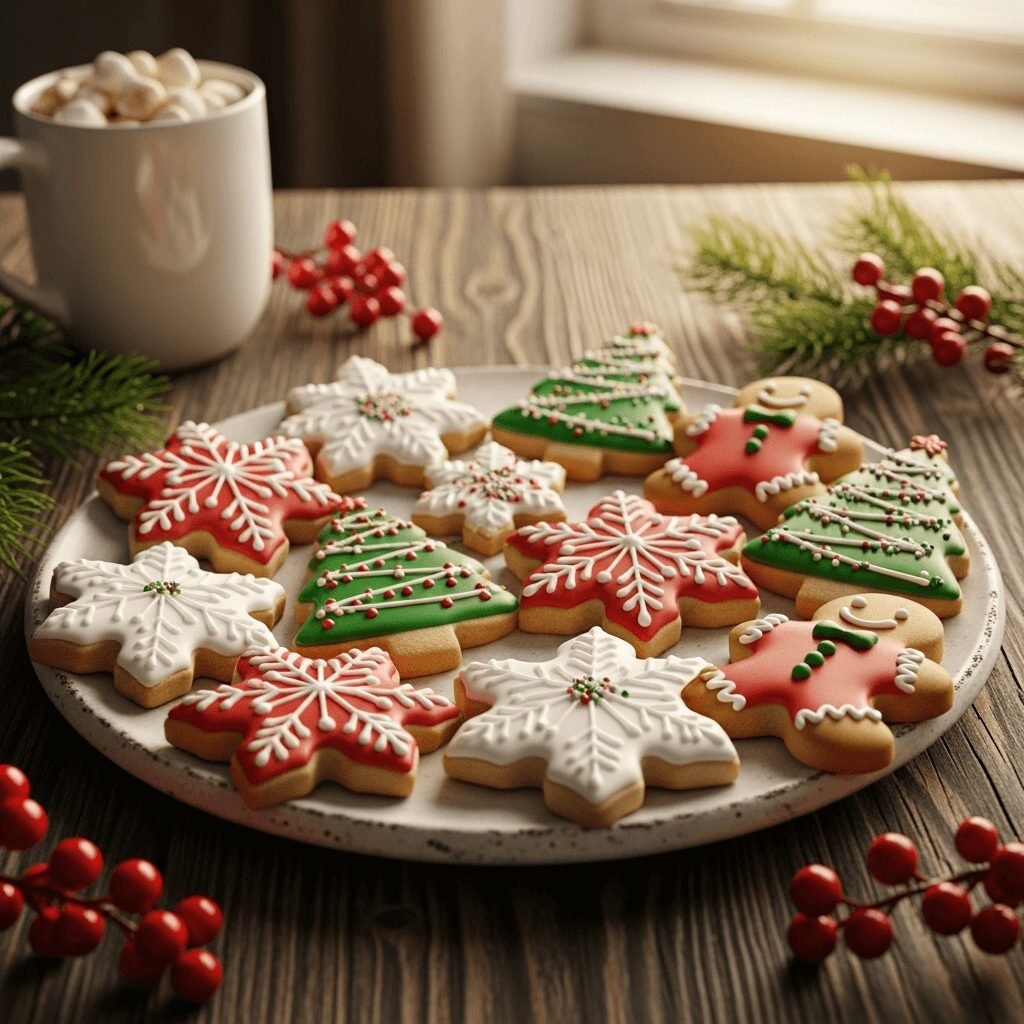
- Cookie cutters – Various festive shapes (stars, trees, gingerbread people, snowflakes, etc.)
- Baking sheets – Two or three for efficient batch baking
- Parchment paper or silicone baking mats – Prevents sticking and makes cleanup easy
- Wire cooling racks – Essential for proper cooling before decorating
- Plastic wrap – For wrapping dough if chilling
- Pastry brush – For dusting excess flour from rolled dough
- Small offset spatula – Helpful for transferring cut cookies to baking sheets
- Piping bags and tips (optional) – If decorating with royal icing
- Sifter or fine-mesh strainer – For mixing dry ingredients
Holiday Cookies Recipe

These classic holiday cookies are soft, buttery sugar cookies perfect for decorating. With a tender texture that holds shape beautifully, they’re ideal for Christmas celebrations, cookie exchanges, and gift-giving. Simple ingredients create foolproof results every time.
- Prep Time: 20 minutes
- Cook Time: 10 minutes
- Total Time: 1 hour
- Yield: 36 cookies (3-inch size) 1x
- Category: Dessert
- Method: Baking
- Cuisine: American
- Diet: Vegetarian
Ingredients
For the Cookies:
- 3 cups all-purpose flour
- 1½ teaspoons baking powder
- ½ teaspoon salt
- 1 cup (2 sticks) unsalted butter, softened to room temperature
- 1 cup granulated sugar
- 2 large eggs, room temperature
- 2 teaspoons pure vanilla extract
For Decorating (Optional):
- Royal icing or buttercream frosting
- Food coloring gels
- Sprinkles, sanding sugar, or nonpareils
- Edible glitter or luster dust
Instructions
Step 1: Prepare Your Workspace
Preheat your oven to 350°F (175°C). Line two baking sheets with parchment paper or silicone baking mats. Set aside. This prevents sticking and ensures even browning on the bottom of your cookies.
Step 2: Mix Dry Ingredients
In a medium bowl, whisk together the flour, baking powder, and salt until well combined. This ensures the leavening agent is evenly distributed throughout the flour, which helps your cookies rise uniformly. Set this bowl aside for now.
Step 3: Cream Butter and Sugar
In a large bowl using a stand mixer or hand mixer, beat the softened butter and sugar together on medium-high speed for 3-4 minutes. The mixture should become light, fluffy, and pale in color. This creaming process incorporates air into the dough, creating a tender cookie texture. Scrape down the sides of the bowl with a rubber spatula to ensure everything is evenly mixed.
Step 4: Add Eggs and Vanilla
Add the eggs one at a time, beating well after each addition until fully incorporated. Pour in the vanilla extract and mix until combined. The mixture may look slightly curdled at this point—that’s completely normal and will come together once you add the flour.
Step 5: Incorporate Dry Ingredients
With the mixer on low speed, gradually add the flour mixture to the wet ingredients in three additions. Mix just until the flour disappears and a soft dough forms. Be careful not to overmix, as this can develop the gluten too much and result in tough cookies. The dough should be soft but not sticky.
Step 6: Chill the Dough (Optional but Recommended)
Divide the dough into two portions and shape each into a flat disk. Wrap tightly in plastic wrap and refrigerate for at least 30 minutes or up to 3 days. Chilled dough is easier to roll out and helps cookies maintain their shape during baking. If you’re short on time, you can skip this step, but your cookies may spread slightly more.
Step 7: Roll Out the Dough
On a lightly floured surface, roll out one disk of dough to about ¼-inch thickness. Keep the other disk refrigerated until you’re ready to use it. If the dough becomes too soft while rolling, pop it back in the fridge for 10 minutes. Use just enough flour to prevent sticking—too much can make cookies tough.
Step 8: Cut Cookie Shapes
Using your favorite cookie cutters, cut out shapes and place them on the prepared baking sheets, spacing them about 2 inches apart. Gather scraps, re-roll gently, and continue cutting until all dough is used. Try to minimize re-rolling as each time makes the dough slightly tougher.
Step 9: Bake to Perfection
Bake cookies for 8-10 minutes, or until the edges are just barely starting to turn golden. The centers will look slightly underdone—that’s perfect! They’ll continue cooking on the hot pan after you remove them from the oven. Overbaking will result in hard, dry cookies instead of the soft texture you want.
Step 10: Cool Completely
Let cookies cool on the baking sheet for 5 minutes, then carefully transfer to a wire cooling rack using a thin spatula. Allow them to cool completely before decorating—at least 30 minutes. Decorating warm cookies will cause icing to melt and slide off.
Step 11: Decorate and Enjoy
Once cookies are completely cool, decorate with royal icing, buttercream, or your favorite toppings. Let decorated cookies dry completely before stacking or storing—this can take 4-6 hours for royal icing depending on humidity levels.
Notes
- Thickness matters: Rolling dough to a consistent ¼-inch thickness ensures even baking. Thicker cookies will be softer; thinner ones will be crispier.
- Temperature is key: Make sure butter is truly softened (should leave a fingerprint when pressed but not be melted or greasy).
- Don’t skip parchment: It prevents sticking and makes cleanup effortless.
- Altitude adjustments: If baking above 3,500 feet, reduce baking powder to 1 teaspoon and increase flour by 2 tablespoons.
- Color consistency: For vibrant decorated cookies, use gel food coloring in your icing rather than liquid—it won’t thin out the consistency.
Nutrition
- Serving Size: 1 cookie (undecorated)
- Calories: 98
- Sugar: 6g
- Sodium: 52mg
- Fat: 5g
- Saturated Fat: 3g
- Unsaturated Fat: 2g
- Trans Fat: 0g
- Carbohydrates: 12g
- Fiber: 0g
- Protein: 1g
- Cholesterol: 23mg
Note: Nutrition information is calculated per cookie based on 36 cookies per batch, without icing or decorations. Values are approximate and will vary based on specific ingredients used and portion sizes.
Tips & Variations
The beauty of this holiday cookies recipe is how wonderfully adaptable it is to your taste preferences and dietary needs. Here are some creative ways to customize these festive treats:
Flavor Variations:
- Almond Holiday Cookies: Replace 1 teaspoon of vanilla with ½ teaspoon almond extract for a subtle nutty flavor
- Lemon Sugar Cookies: Add 2 tablespoons fresh lemon zest and replace vanilla with lemon extract
- Spiced Holiday Cookies: Mix in ½ teaspoon cinnamon, ¼ teaspoon nutmeg, and a pinch of ginger to the dry ingredients
- Brown Butter Version: Brown your butter first and let it cool completely before using—adds incredible nutty depth
- Chocolate Cookies: Replace ½ cup flour with unsweetened cocoa powder for chocolate holiday cookies
Dietary Modifications:
- Gluten-Free: Use a 1:1 gluten-free flour blend (like Bob’s Red Mill) in place of all-purpose flour
- Dairy-Free: Substitute vegan butter (stick form, not spreadable) and ensure your decorations are dairy-free
- Reduced Sugar: You can reduce sugar to ¾ cup, though cookies will be less tender and spread less
Decorating Ideas:
- Classic Royal Icing: Creates a smooth, hardened finish perfect for detailed designs and stacking
- Buttercream Frosting: Softer, creamier texture that tastes incredibly indulgent
- Simple Glaze: Mix powdered sugar with milk and food coloring for easy decoration
- Colored Sugar Before Baking: Sprinkle on shaped cookies before baking for a sparkly, easy finish
- Dipped Cookies: Dip half of each cookie in melted chocolate and let set on parchment
Pro Chef Tips
Taking your holiday cookies from good to absolutely spectacular requires just a few professional techniques that make all the difference:
Measure Flour Correctly: This is the single most important tip for perfect cookies. Spoon flour into your measuring cup and level it off with a knife. Scooping directly from the bag compacts the flour, giving you up to 25% more flour than the recipe intends, resulting in dry, tough cookies.
Room Temperature Ingredients: Butter, eggs, and even flour should be at room temperature. This allows everything to emulsify properly, creating a smooth, uniform dough. Cold ingredients can cause the butter to seize up and create an uneven texture.
Don’t Overmix: Once you add the flour, mix just until combined. Overmixing develops gluten strands, making cookies tough and chewy instead of tender and delicate. You want to see no flour streaks, but stop immediately once that happens.
Rotate Your Pans: Halfway through baking, rotate your cookie sheets 180 degrees. This compensates for any hot spots in your oven and ensures even browning. If baking two sheets at once, also switch racks.
Use an Oven Thermometer: Most home ovens are off by 25-50 degrees. An inexpensive oven thermometer ensures you’re baking at the correct temperature, preventing underbaked or overbaked cookies.
Chill Your Tools: If your kitchen is warm or you notice the dough becoming too soft while rolling, pop your rolling pin in the freezer for 10 minutes. A cold rolling pin helps keep the butter in the dough firm, preventing excessive spreading.
Freeze for Clean Cuts: For extremely precise shapes with intricate details, cut your shapes and then freeze the entire baking sheet for 10 minutes before baking. This helps cookies hold their shape perfectly, even with thin details.
Test Bake One Cookie: Before baking entire sheets, bake just one or two test cookies. This allows you to adjust baking time for your specific oven without risking an entire batch.
Common Mistakes to Avoid
Even experienced bakers can run into issues with sugar cookies. Here are the most common problems and how to prevent them:
Cookies Spread Too Much: This usually happens when butter is too soft or melted, the dough is too warm, or there’s not enough flour. Make sure butter is softened but still holds its shape. If dough feels greasy or very soft, refrigerate for 15-20 minutes before cutting. Also ensure you’re measuring flour correctly by spooning and leveling.
Cookies Are Tough or Hard: Overmixing after adding flour, using too much flour, or overbaking causes this. Mix only until flour disappears, measure flour accurately, and remove cookies when edges are just barely golden but centers still look slightly soft. They’ll firm up as they cool.
Cookies Lose Their Shape: This happens when dough is too warm during cutting and baking, or oven temperature is too low. Chill your dough properly, work quickly when cutting shapes, and consider freezing cut cookies for 10 minutes before baking. Verify your oven temperature with a thermometer.
Dry, Crumbly Dough: Not enough fat or liquid, or too much flour. Make sure you’re measuring flour correctly and that your butter is properly softened (not cold). If dough seems dry, you can add 1-2 tablespoons of milk, one tablespoon at a time, until it comes together.
Uneven Baking: Some cookies are done while others are still pale. This indicates hot spots in your oven or inconsistent cookie thickness. Rotate pans halfway through baking, and make sure you’re rolling dough to an even thickness throughout. Using an oven thermometer and rotating pans helps significantly.
Bottom Burns Before Top Bakes: Your oven’s bottom element may be too hot, or you’re placing cookies too low in the oven. Bake on the middle rack, use light-colored baking sheets (dark ones absorb more heat), and consider double-stacking baking sheets for extra insulation.
Storage & Meal Prep
Proper storage keeps your holiday cookies tasting fresh and delicious for days, even weeks if done correctly:
Room Temperature Storage: Store completely cooled, decorated cookies in an airtight container at room temperature for up to 1 week. Place parchment paper or wax paper between layers to prevent sticking. Make sure cookies are completely dry before stacking—royal icing typically needs 4-6 hours to fully set.
Refrigerator Storage: While not necessary, you can refrigerate decorated cookies in an airtight container for up to 2 weeks. This is especially helpful in warm, humid environments where cookies might become soft. Let them come to room temperature before serving for the best texture.
Cookie Dough Storage: Unbaked dough stores beautifully! Wrap tightly in plastic wrap and refrigerate for up to 5 days or freeze for up to 3 months. When ready to use, thaw frozen dough overnight in the refrigerator, then bring to room temperature for 15-20 minutes before rolling.
Baked, Undecorated Cookies: These actually freeze better than decorated ones. Place cooled cookies in a single layer on a baking sheet and freeze until solid (about 2 hours), then transfer to freezer bags or airtight containers, separating layers with parchment paper. Freeze for up to 3 months. Thaw at room temperature for 30 minutes before decorating.
Decorated Cookies for Shipping: If mailing cookies as gifts, wait until royal icing is completely hardened (overnight is best), then wrap each cookie individually in plastic wrap. Place wrapped cookies in an airtight container with bubble wrap or crumpled parchment paper for cushioning. Ship in sturdy boxes and consider 2-3 day shipping to maintain freshness.
Make-Ahead & Freezer Notes
Holiday baking becomes so much more manageable when you plan ahead. Here’s how to break up the work:
Prepare Dough in Advance: Make your cookie dough up to 3-5 days before baking and store it wrapped tightly in the refrigerator. This actually improves the flavor as the ingredients have time to meld together. When ready to bake, let the dough sit at room temperature for 15-20 minutes to make rolling easier.
Freeze Cookie Dough: For ultimate make-ahead convenience, freeze cookie dough for up to 3 months. You can freeze it as a disk (wrapped in plastic wrap and then in a freezer bag), or roll it out, cut shapes, and freeze the cut cookies on baking sheets. Once frozen solid, transfer to freezer bags. Bake from frozen, adding 1-2 extra minutes to baking time.
Batch Baking Strategy: On one day, make multiple batches of dough and freeze them. On baking day, you can pull out just what you need and have fresh cookies without all the prep work. This is perfect for hosting multiple holiday events without the stress.
Freeze Baked Cookies: Undecorated cookies freeze exceptionally well. Bake your cookies a month before the holidays, freeze them properly (see storage section above), and decorate them fresh as needed. This spreads out your workload and ensures you’re never scrambling at the last minute.
Assembly Line Decorating: If making cookies for a large event, bake all cookies one day, make your icing and organize your decorating station the next day, and decorate on the third day. Breaking it into stages prevents burnout and allows for quality control at each step.
Best Thawing Method: For frozen dough, thaw overnight in the refrigerator, then let sit at room temperature for 15-20 minutes before rolling. For frozen baked cookies, thaw at room temperature in their container (don’t unwrap until thawed) for 1-2 hours. This prevents condensation from making cookies soggy.
Serving Suggestions
Holiday cookies are wonderfully versatile and pair beautifully with so many festive treats and beverages. Here are some delightful ways to serve your creations:
Classic Holiday Pairings:
- Hot cocoa or hot chocolate with marshmallows and peppermint sticks
- Freshly brewed coffee (especially vanilla or hazelnut flavored)
- Warm spiced apple cider or mulled wine for adult gatherings
- Eggnog (spiked or virgin) for an extra festive touch
- Cold milk in festive glasses for kids’ parties
- Chai tea or Earl Grey tea for afternoon cookie exchanges
Create a Cookie Platter: Arrange your holiday cookies on a large platter or tiered stand alongside complementary treats like fudge, peppermint bark, chocolate truffles, and candied nuts. This creates a stunning visual display perfect for holiday parties and makes for beautiful photos.
Cookie Gift Boxes: Package 6-12 cookies in clear cellophane bags tied with festive ribbon, or use decorative cookie tins lined with tissue paper. Add a personalized gift tag with the cookie name and date. These make heartfelt, budget-friendly gifts for teachers, neighbors, mail carriers, and coworkers.
Cookie Exchange Presentation: If attending a cookie exchange, arrange your cookies on a festive platter and bring recipe cards so others can recreate your delicious creation. Consider adding small bags so guests can take samples home.
Dessert Charcuterie Board: Include these cookies on a dessert board with fresh berries, chocolate-covered pretzels, mini cheesecakes, and cream cheese dip. The variety of textures and flavors creates an impressive spread.
Kids’ Holiday Party: Serve cookies with vanilla ice cream, letting kids make ice cream sandwiches. Set up a hot cocoa bar where children can customize their drinks with marshmallows, whipped cream, and crushed candy canes, enjoying their decorated cookies alongside.
FAQs Section
Q: Can I make this dough without a mixer?
A: Absolutely! While a mixer makes creaming butter and sugar easier, you can make excellent cookies by hand. Use a wooden spoon and put some elbow grease into creaming the butter and sugar—it should take about 5-7 minutes to get light and fluffy. The results will be just as delicious.
Q: Why did my cookies spread during baking?
A: Cookie spreading usually happens for a few reasons: butter that’s too soft or melted, dough that’s too warm when it goes into the oven, not enough flour, or oven temperature that’s too low. Make sure your butter is softened but still holds its shape, chill your dough before cutting, and verify your oven temperature with an oven thermometer. If you live in a warm climate, try freezing cut cookies on the baking sheet for 10 minutes before baking.
Q: How far in advance can I bake these cookies?
A: You can bake these cookies up to 1 month in advance if you freeze them properly. Bake cookies, let them cool completely, freeze in a single layer until solid, then transfer to airtight freezer containers with parchment between layers. Thaw at room temperature before decorating. For decorated cookies, you can make them 1 week ahead and store at room temperature in airtight containers.
Q: What’s the best icing for decorating holiday cookies?
A: Royal icing is the gold standard for decorating because it dries hard and smooth, perfect for intricate designs and stacking cookies. However, buttercream frosting offers a softer, creamier taste that many prefer. For beginners, a simple powdered sugar glaze (powdered sugar mixed with milk and vanilla) works wonderfully and is much easier to work with. Choose based on your skill level and desired presentation.
Q: Can I double this recipe?
A: Yes, this recipe doubles and even triples beautifully! Make sure you have a large enough mixing bowl and mix thoroughly to ensure even distribution of ingredients. You might need to work in batches when rolling and cutting if your work surface is limited. Doubled batches are perfect for cookie exchanges or large holiday gatherings.
Q: My dough is too sticky to roll out. What should I do?
A: If your dough is too sticky, it’s likely too warm or you may need a bit more flour. First, try refrigerating the dough for 30 minutes—this usually solves the problem. If it’s still sticky after chilling, you can knead in flour 1 tablespoon at a time until it reaches a workable consistency, but be careful not to add too much or cookies will be tough. Working on a lightly floured surface and dusting your rolling pin also helps prevent sticking.
Q: How do I get clean, sharp edges on my cut-out cookies?
A: Sharp edges come from cold dough and quick work. Roll your dough, cut shapes, and immediately transfer the baking sheet to the freezer for 10 minutes before baking. Use sharp cookie cutters (dull cutters compress edges) and dip them in flour between cuts. When transferring cut cookies to the baking sheet, use a thin metal spatula and handle them gently to avoid distorting shapes. The chilling step before baking is crucial for maintaining crisp edges.
Conclusion
There’s something incredibly special about baking holiday cookies that transcends the simple act of mixing ingredients and cutting shapes. These buttery, tender cookies carry the warmth of tradition, the joy of creativity, and the love that goes into every batch you make. Whether you’re continuing a cherished family tradition or starting a new one, these classic holiday cookies will fill your home with the sweet aromas and happy memories that make the season truly magical.
This foolproof recipe ensures success for bakers of all skill levels, from first-time cookie makers to seasoned pros looking for a reliable go-to. The simple ingredient list, straightforward technique, and endless decorating possibilities make these cookies perfect for any holiday occasion—from intimate family gatherings to large cookie exchanges and everything in between.
Now it’s your turn to create some delicious magic in your kitchen! Roll up your sleeves, gather your loved ones, and start baking these wonderful holiday cookies. Don’t forget to snap a photo of your beautiful creations and share your decorating ideas with fellow bakers. Pin this recipe to your favorite Pinterest board so you’ll have it ready whenever the holiday baking spirit strikes!
Have you tried this recipe? I’d love to hear how your cookies turned out! Drop a comment below with your favorite decorating technique or flavor variation. Happy baking, and may your holidays be filled with sweetness! 🎄✨